Thermodynamics
Energy and work
Thermodynamics studies energy transformations in the universe and tells us whether a given physical process is possible.
Energy
Energy is the capacity to do work. One newton-metre is one joule (1 N·m = 1 J).
A calorie (cal) is the heat energy needed to raise the temperature of 1 gram of water by 1 °C; 1 cal = 4.184 J. A kilocalorie (kcal) is 1000 calories: 1 kcal = 1000 cal = 4184 J.
Work
Work can be defined two ways.
Force–displacement form
- — work (energy transferred by a force acting through a displacement), joule (J)
- — force, newton (N)
- — displacement, metre (m)
Pressure–volume form
- — work (energy transferred by expansion or compression against an external pressure), joule (J)
- — pressure, pascal (Pa)
- — change in volume, cubic metre (m³)
System, surroundings, and universe
System is the matter within a specific region of space under consideration. Surroundings is the matter in the rest of the universe. System plus surroundings equals the universe.
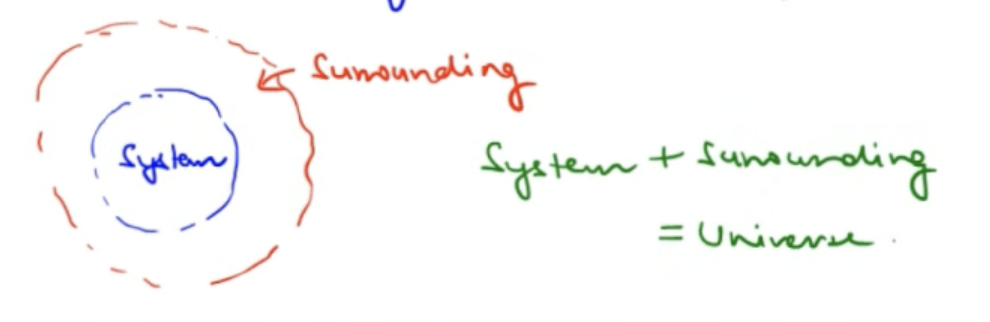
Types of system
| System type | Mass transfer | Energy transfer |
|---|---|---|
| Open | Yes | Yes |
| Closed | No | Yes |
| Isolated | No | No |
State functions
State functions are properties that depend only on the initial and final state of the system, not on the path the system follows between them.
Pressure, volume, internal energy, enthalpy, entropy, and free energy are all state functions. Because a state function's value depends only on the state, its change is written with — for example for the change in internal energy.
Work and heat depend on the path the system follows, not just its initial and final state, so they are path functions — non-state functions.
| State function | Path function | |
|---|---|---|
| Depends on | Initial and final state only | Path taken |
| Examples | Pressure, volume, internal energy, enthalpy, entropy, free energy | Work, heat |
| Change written as | Not written with |
Zeroth law of thermodynamics
The zeroth law of thermodynamics states that if system A is in thermal equilibrium with system B, and system B is in thermal equilibrium with system C, then system A is also in thermal equilibrium with system C.
Two systems are in thermal equilibrium when no net heat flows between them — they are at the same temperature. The zeroth law is what makes temperature a well-defined, measurable property: a thermometer (system B) can be brought into equilibrium with A, then with C, and if both read the same temperature, A and C are in equilibrium with each other without ever being placed in contact.
First law of thermodynamics
The first law of thermodynamics states that the total energy of a system and its surroundings is constant.
Energy can neither be created nor destroyed — it can only be transformed from one form to another. This is the law of conservation of energy.
Internal energy
Internal energy is the total energy contained within a system. It is a state function, and it can change only if energy flows into or out of the system as heat or work.
- — change in internal energy (net energy gained or lost by the system as heat and work cross its boundary), joule (J)
- — final internal energy of the system, joule (J)
- — initial internal energy of the system, joule (J)
Internal energy also changes according to how heat and work cross the system boundary:
- — heat transferred across the system boundary, joule (J)
- — work transferred across the system boundary, joule (J)
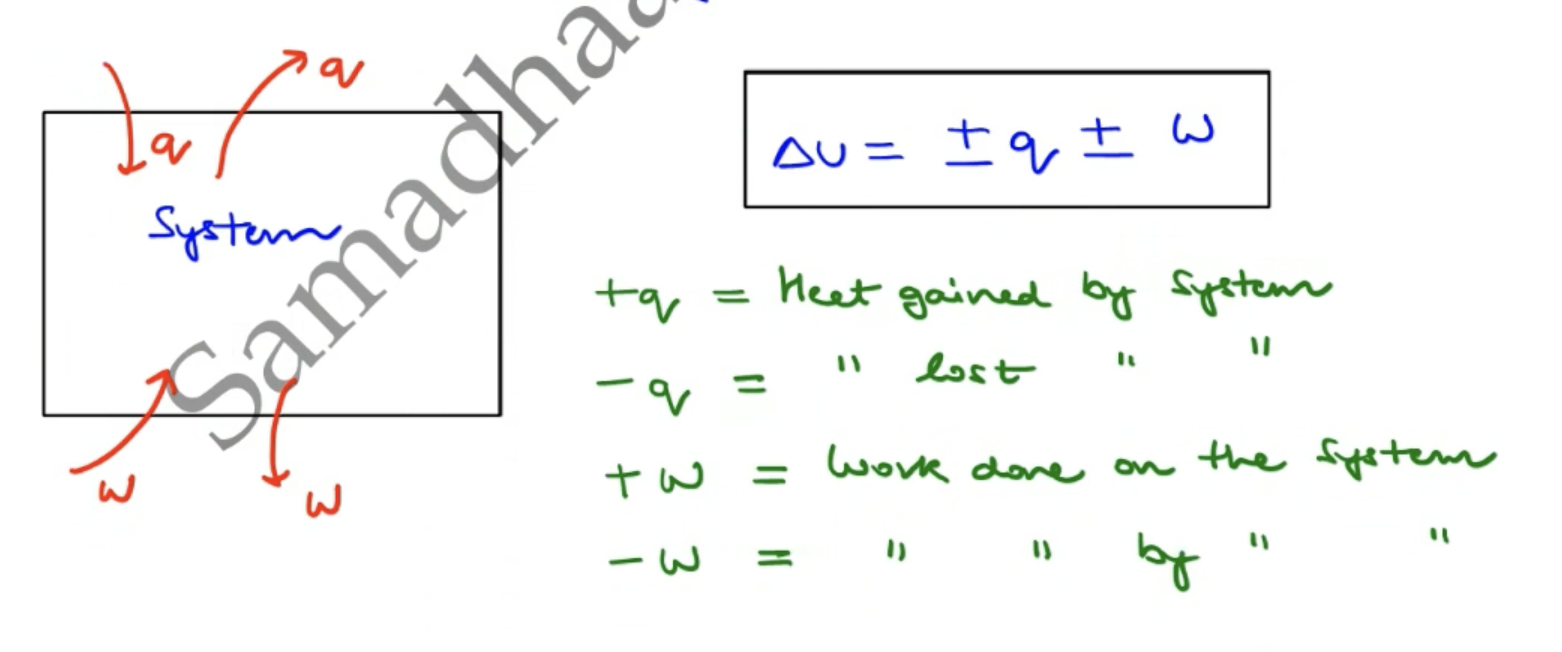
- — heat gained by the system
- — heat lost by the system
- — work done on the system
- — work done by the system
At constant volume, , so no pressure–volume work is done and the first law reduces to — the change in internal energy equals the heat exchanged at constant volume.
Enthalpy
In biological systems, volume is not constant — pressure is constant instead. This is why enthalpy is introduced: it is the heat exchanged at constant pressure.
When volume changes at constant pressure, part of the energy released goes into pushing back the surroundings — the term — energy spent, but not felt as heat. Enthalpy is internal energy plus that unavoidable boundary-pushing work, so is the part left over as heat a thermometer or calorimeter actually detects. This is why a vented bioreactor, whose pressure stays roughly constant while its volume does not, is tracked by enthalpy rather than internal energy.
- — change in enthalpy (the heat exchanged at constant pressure — internal energy minus the boundary-pushing work not felt as heat), joule (J)
- — change in internal energy, joule (J)
- — pressure, pascal (Pa)
- — change in volume, cubic metre (m³)
At constant pressure, — the change in enthalpy equals the heat exchanged at constant pressure. A positive is endothermic (the system absorbs heat); a negative is exothermic (the system releases heat).
If both pressure and volume are constant, , so and .
Enthalpy is itself a state function, because it is built from a combination of other state functions — internal energy, pressure, and volume.
Worked example: enthalpy vs. internal energy in a vented bioreactor
Question. An aerobic fermentation runs in a bioreactor vented to hold a constant headspace pressure of 101.3 kPa (1 atm). Over one hour, the culture's respiration is exothermic enough that the cooling jacket has to remove 850 kJ of heat to hold temperature — so kJ. Off-gas analysis shows CO production exceeds O consumption enough that the gas phase expands by 50 L ( m³) over that hour. Find for the hour, and compare it with .
Solution.
- At constant pressure, kJ.
- Compute the pressure–volume work term: kJ.
- Rearrange to solve for : kJ.
Answer: kJ, compared with kJ — a difference of about 5 kJ, or roughly 0.6% of the total.
That 5 kJ is real energy: it is what left the system as gas-phase expansion work against the vent, not as heat the jacket could remove. It is small here because the gas volume change is small relative to the heat released, but it is exactly the term you would need to close an energy balance around the headspace or size an off-gas system — and in a sealed, gas-generating process where is larger, it stops being a rounding error.
Bond energy
Bond energy (or bond enthalpy) is the energy required to break a bond — breaking a bond is endothermic. Forming a bond releases energy — bond formation is exothermic. Bond energy is itself an enthalpy term.
Entropy
Entropy is a measure of randomness, disorder, or chaos in a system. Systems with low entropy are structured and ordered; systems with high entropy are less structured.
Examples of increasing entropy:
- Ice → water — a fixed, ordered crystal lattice becomes a disordered liquid; entropy increases.
- Starch → glucose — one large ordered polymer breaks into many small, freely moving molecules; entropy increases.
- Glucose → carbon dioxide and water — one molecule becomes several simpler, more freely moving molecules; entropy increases.
- Folded protein → unfolded protein — a defined three-dimensional structure unravels into a disordered chain; entropy increases.
Ecological succession also illustrates changing structure over time: pioneer (or founder) community → seral community → climax community — a sparse, simple community develops into a complex, highly structured ecosystem, so entropy decreases (order increases) as succession proceeds.
Entropy in biochemical systems
Bond order. Going from single bonds to double bonds to triple bonds, entropy decreases — a single bond allows free rotation around it, while double and triple bonds are progressively more rigid and restrict molecular motion.
Monomers versus polymers. A polymer is more ordered than its free monomers, so it has lower entropy — glycogen (a polymer) has lower entropy than free glucose (its monomer).
Second law of thermodynamics
The second law of thermodynamics states that the total entropy of a system and its surroundings always increases for an irreversible process.
Naturally occurring processes proceed toward equilibrium — a state of minimum potential energy — and systems tend to flow from ordered states toward disordered states.
- — change in entropy (change in the system's disorder — positive for any spontaneous, irreversible process), joule per kelvin (J/K)
- — final entropy of the system, joule per kelvin (J/K)
- — initial entropy of the system, joule per kelvin (J/K)
For a spontaneous (irreversible) process, .
Biological systems and the second law
Biological systems are not exceptions to the second law. When part of a system appears to become more ordered — a growing cell assembling disordered nutrients into ordered biomass, for instance — the entropy of the surroundings increases by more than enough to compensate, so the total entropy of system plus surroundings still increases.
Worked example: does a growing cell violate the second law?
Question. Over one hour, a growing microbial culture assembles disordered nutrients (glucose, amino acids) into ordered biomass, decreasing the system's entropy by kJ/K. In that same hour, the culture's respiration releases 850 kJ of heat to the surroundings (the reactor's cooling water), held at a constant K (37 °C). Find and , and check whether the second law holds.
Solution.
- For a large reservoir at constant temperature, heat released by the system raises the surroundings' entropy by .
- kJ/K.
- kJ/K.
Answer: kJ/K — positive, so the second law holds. The cell's own entropy fell, but the heat it released into the surroundings raised their entropy by more, so the total for system plus surroundings still increased.
Entropy of the surroundings
- — change in entropy of the surroundings, joule per kelvin (J/K)
- — change in enthalpy of the system, joule (J)
- — temperature of the surroundings, kelvin (K)
A negative (an exothermic reaction) raises ; a positive (an endothermic reaction) lowers it.
Gibbs free energy
Gibbs free energy () is the energy available to do actual work. is used to assess whether a reaction is spontaneous.
- — change in Gibbs free energy, joule (J)
- — change in enthalpy, joule (J)
- — absolute temperature, kelvin (K)
- — change in entropy, joule per kelvin (J/K)
| Reaction | |
|---|---|
| Negative | Spontaneous |
| Positive | Non-spontaneous |
| Zero | At equilibrium |
Predicting spontaneity from and
| Spontaneity | ||
|---|---|---|
| Negative | Positive | Always spontaneous |
| Positive | Negative | Never spontaneous |
| Negative | Negative | Depends on the magnitudes of and — spontaneous only if works out negative |
| Positive | Positive | Depends on the magnitudes of and — spontaneous only if works out negative |
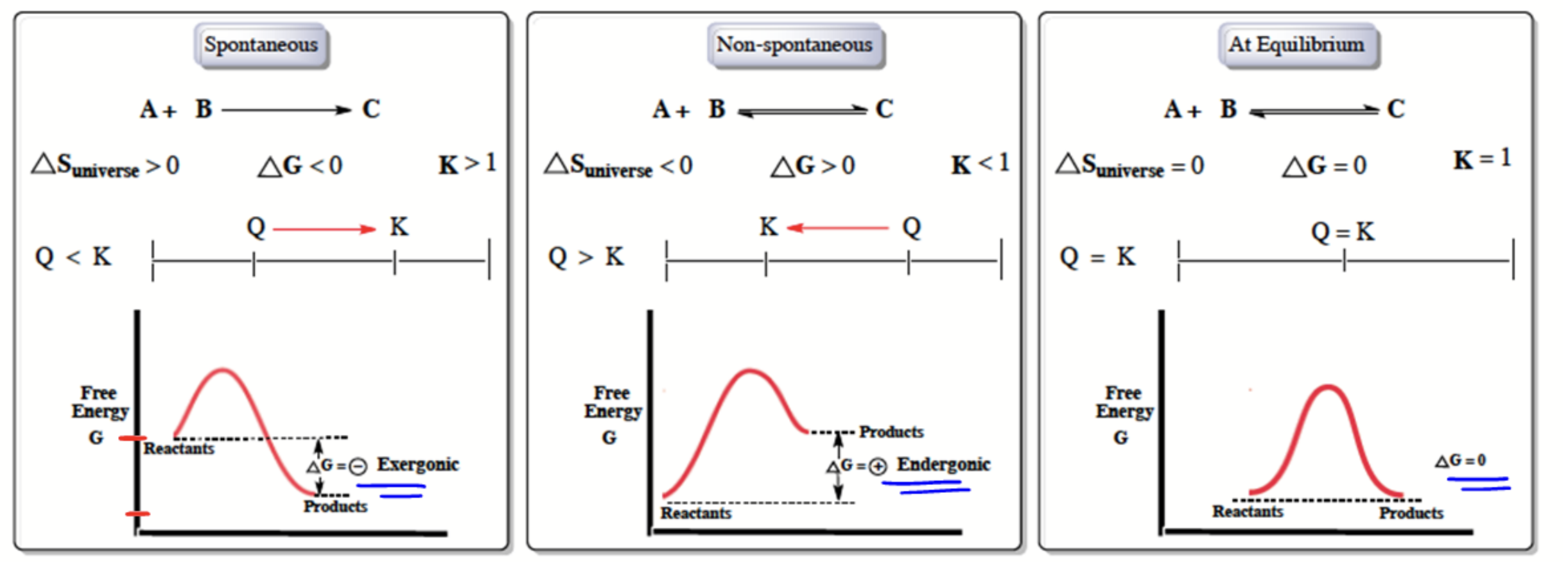
A substance at its melting temperature is at equilibrium between solid and liquid phases, so there.
says nothing about the rate of a reaction — only whether it is spontaneous, not whether it is fast or slow.