GATE BT 2026 — Solved Paper
The GATE 2026 Biotechnology (BT) paper, organized by IIT Guwahati: 65
questions total — General Aptitude (Q1–10), then the BT subject section
(Q11–65). Each question below is tagged with its item number from
the GATE BT syllabus (section.topic.item)
so counts can be rolled up to see which areas get tested most — see the
Topics tab above for the running breakdown. General Aptitude questions
aren't part of that syllabus tree and are tagged general-aptitude instead,
shown separately there.
General Aptitude (Q1–10)
Q1 — 1 mark, MCQ
Question. "He often _____ the numbers. False claims are not going to help. Honesty _____ trust," said the manager. Choose the option with the correct order of words to fill the blanks.
- (A) exaggerates; engenders
- (B) excels; encourages
- (C) aggravates; alleviates
- (D) diminishes; eliminates
Solution
The second sentence ("False claims are not going to help") tells us the first blank describes a dishonest habit with numbers — so the first blank must mean overstates, not understates: rules out (C) and (D). Between (A) and (B), "excels the numbers" isn't idiomatic (excel is intransitive here), while "exaggerates the numbers" is exactly the dishonest habit the sentence is warning about. For the second blank, "honesty engenders trust" (engenders = brings about) is the standard sense — "honesty encourages trust" is grammatically fine but weaker/less precise than the intended pairing, and (A) reads cleanly as a matched pair.
Answer: (A) exaggerates; engenders
Q2 — 1 mark, MCQ
Question. In the sequence of tiles shown, the missing tile (marked "?") should be which pattern?
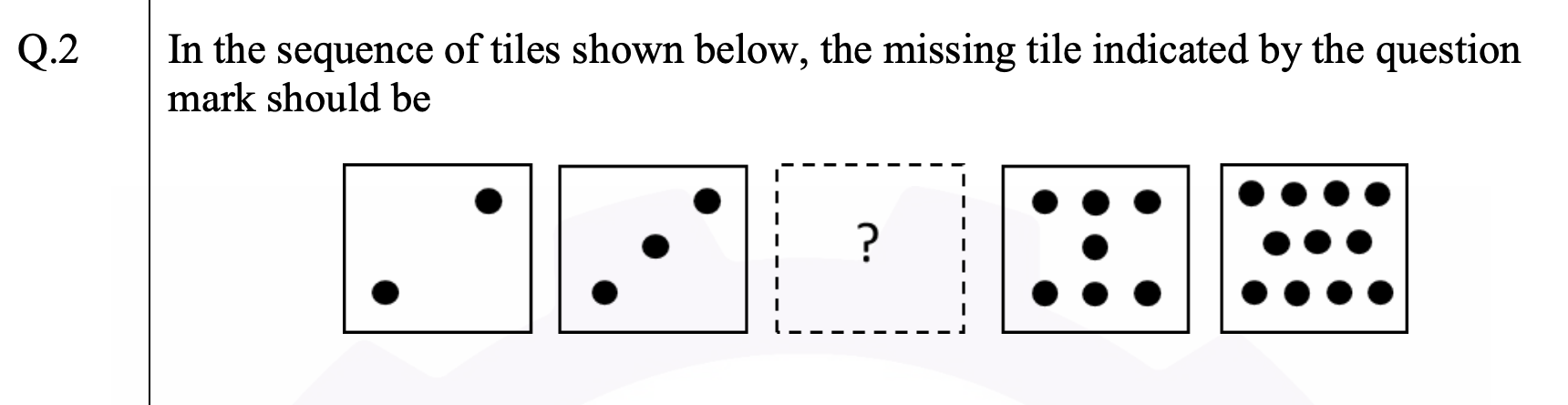
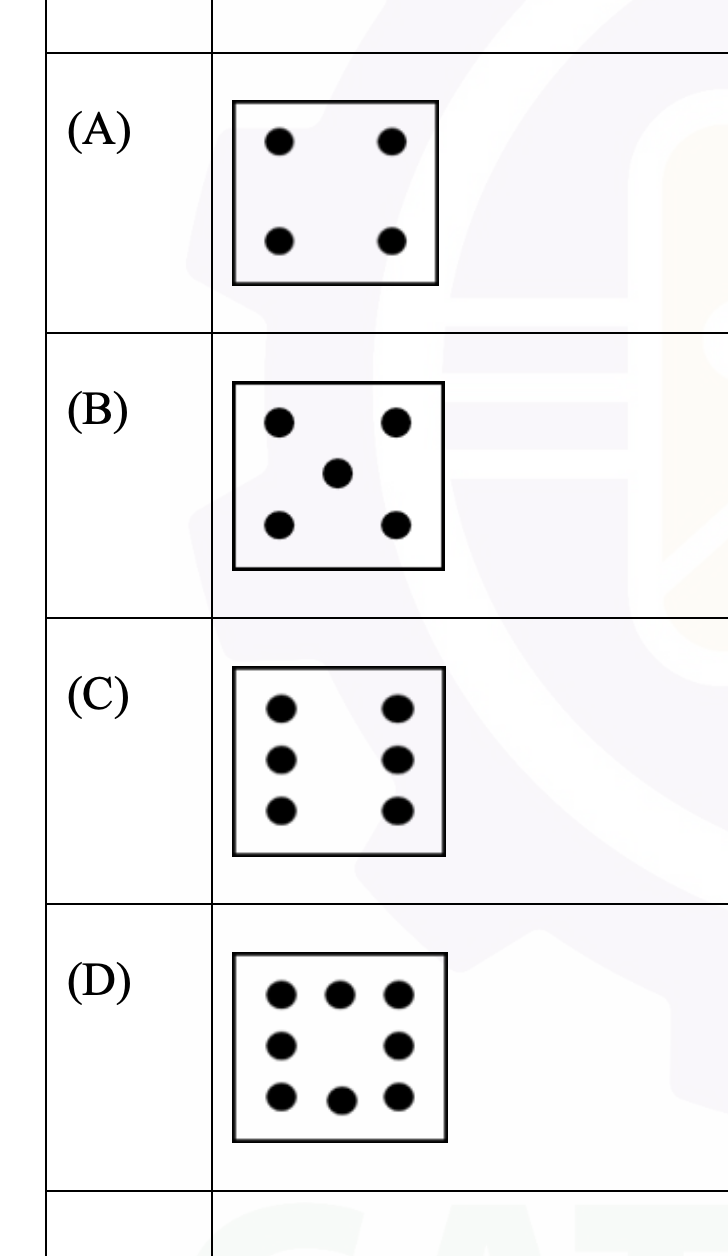
- (A) 4 dots (2×2 square)
- (B) 5 dots
- (C) 6 dots
- (D) 8 dots
Solution
The dot counts are the first five prime numbers: 2, 3, ?, 7, 11. The missing (3rd) tile is the 3rd prime, 5.
Answer: (B) 5 dots
Q3 — 1 mark, MCQ
Question. A school has 100 students distributed among 1st to 10th standards. Which one of the following statements is always correct?
- (A) There are at least 10 students who belong to the same standard.
- (B) There is at least one student in each standard.
- (C) There are at most 10 students in 10th standard.
- (D) The total number of students from 1st to 5th standards is at least 50.
Solution
- — total number of items
- — number of groups the items are split into
This is a pigeonhole argument: 100 students spread over 10 standards average exactly 10 per standard, so at least one standard must have 10 or more — if every standard had 9 or fewer, the total would be at most 90 < 100, a contradiction. (B), (C), and (D) each describe one possible distribution, not one forced by the numbers (e.g. all 100 students could be in a single standard, satisfying (A) but violating (B), (C), and (D)).
Answer: (A)
Q4 — 1 mark, MCQ
Question. How many 3-digit numbers can be formed using three distinct single-digit prime numbers?
- (A) 64
- (B) 24
- (C) 12
- (D) 4
Solution
- — total number of items available
- — number chosen and arranged (order matters)
The single-digit primes are 2, 3, 5, 7 — four digits. A 3-digit number using three distinct ones is an ordered selection of 3 from 4 (order matters, since 235 ≠ 253), and none of these digits is 0 so every arrangement is a valid 3-digit number. Count = .
Answer: (B) 24
Q5 — 1 mark, MCQ
Question. In a group of students, 10 students like Mathematics, 12 students like English, 4 students like both Mathematics and English, and 6 students like neither. The number of students in the group is ____.
- (A) 18
- (B) 20
- (C) 24
- (D) 32
Solution
- , — count of items with property , with property
- — count of items with both properties
By inclusion-exclusion, students who like at least one subject = . Adding the 6 who like neither: total .
Answer: (C) 24
Q6 — 2 marks, MCQ
Question. Charity : P :: Retaliation : Q. Choose the appropriate pair of words P and Q that fit the analogy.
- (A) P = Parsimonious; Q = Vengeful
- (B) P = Altruistic; Q = Amicable
- (C) P = Resentful; Q = Spiteful
- (D) P = Magnanimous; Q = Vindictive
Solution
The analogy pairs an act with the trait of a person who performs it: charity is done by someone who is magnanimous (generous), and retaliation is done by someone who is vindictive (bent on revenge). (A) pairs charity with its opposite trait (parsimonious = stingy), breaking the pattern; (B) and (C) don't consistently match either act to its performer's trait.
Answer: (D) P = Magnanimous; Q = Vindictive
Q7 — 2 marks, MCQ
Question. A paper shown in Panel I is folded along the dashed lines to construct a cube; the shaded regions in Panel I appear on the outer surface of the cube. Referring to the cubes in Panel II, which one of the options is correct — (i) only, (ii) only, both, or neither?
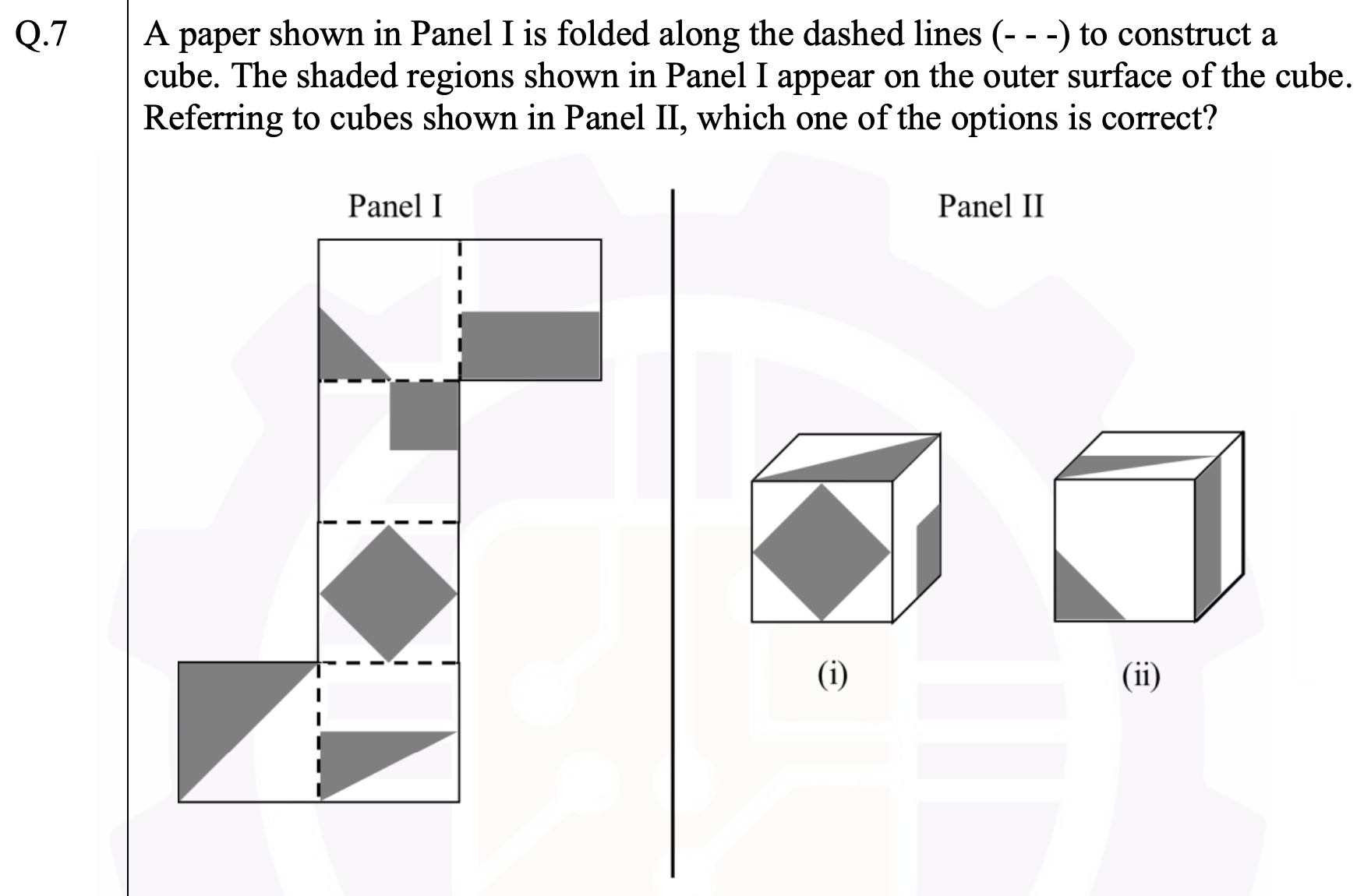
- (A) Only (i) can correspond to the unfolded cube in Panel I.
- (B) Only (ii) can correspond to the unfolded cube in Panel I.
- (C) Both (i) and (ii) can correspond to the unfolded cube in Panel I.
- (D) Neither (i) nor (ii) can correspond to the unfolded cube in Panel I.
Solution
The diamond-square sits two folds away from the top-left square in both directions, so it lands on the same face regardless of fold order, and both rendered options correctly put it on the front face — that part doesn't discriminate between (i) and (ii). The solid-black square and the two corner triangles are what differ between them, and tracing exactly which cube edge each lands on (by physically folding the net, or walking through it face by face) shows only option (i) reproduces the shading in Panel I correctly — (ii) has one of the corner triangles on the wrong face/orientation.
Answer: (A) Only (i)
Q8 — 2 marks, MCQ
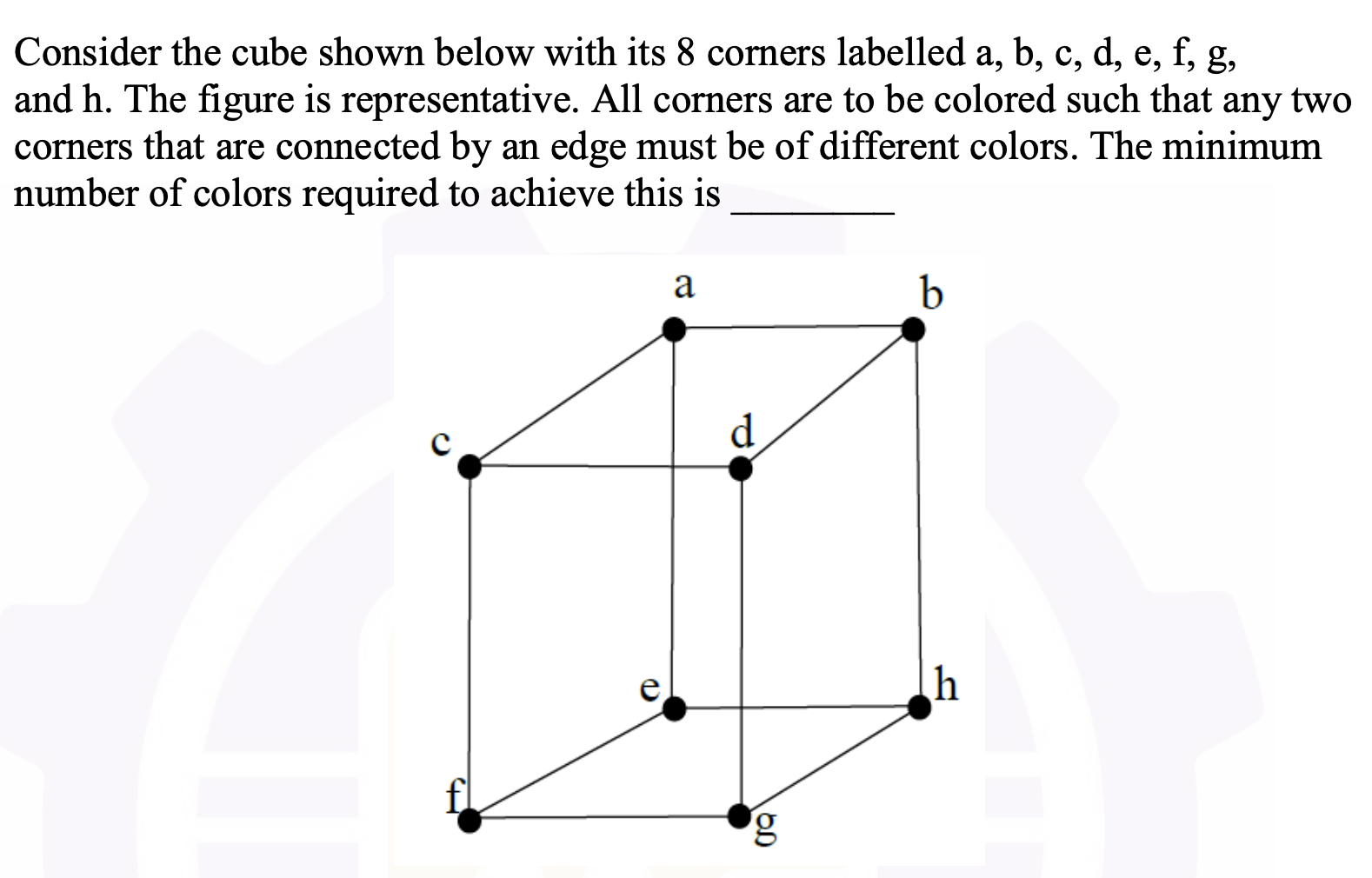
Question. Consider a cube with its 8 corners labelled a–h. All corners are colored such that any two corners connected by an edge must be different colors. The minimum number of colors required is ____.
- (A) 8
- (B) 4
- (C) 3
- (D) 2
Solution
The cube's vertex-edge graph is bipartite: split the 8 corners into two sets by parity — e.g. label each corner by how many of its 3 binary coordinates are 1; every edge of a cube connects a vertex of even parity to one of odd parity, never same-to-same. Coloring one parity class one color and the other a second color satisfies the constraint, and one color alone can't work since adjacent corners would clash — so the minimum is 2.
Answer: (D) 2
Q9 — 2 marks, MCQ
Question. Four hills H1–H4 satisfy: (i) neither H2 nor H3 is easternmost; (ii) neither H2 nor H3 is westernmost; (iii) neither the easternmost nor the westernmost hill is the southernmost; (iv) two hills are located to the west of H2; (v) the southernmost hill has at least two hills to its east. The southernmost hill is ____.
- (A) H1
- (B) H2
- (C) H3
- (D) H4
Solution
From (i) and (ii), H2 and H3 occupy the two middle west–east positions, leaving H1 and H4 to occupy the westernmost and easternmost ends (in some order). From (iv), exactly two hills lie west of H2, which fixes H2 at the 3rd position from the west; H3 then takes the 2nd position. From (v), the southernmost hill must have ≥2 hills to its east, which is only possible from the 1st or 2nd position (west–east). From (iii), the southernmost hill can't be at the westernmost (1st) or easternmost (4th) position. The only position satisfying both is the 2nd — which is H3.
Answer: (C) H3
Q10 — 2 marks, MCQ
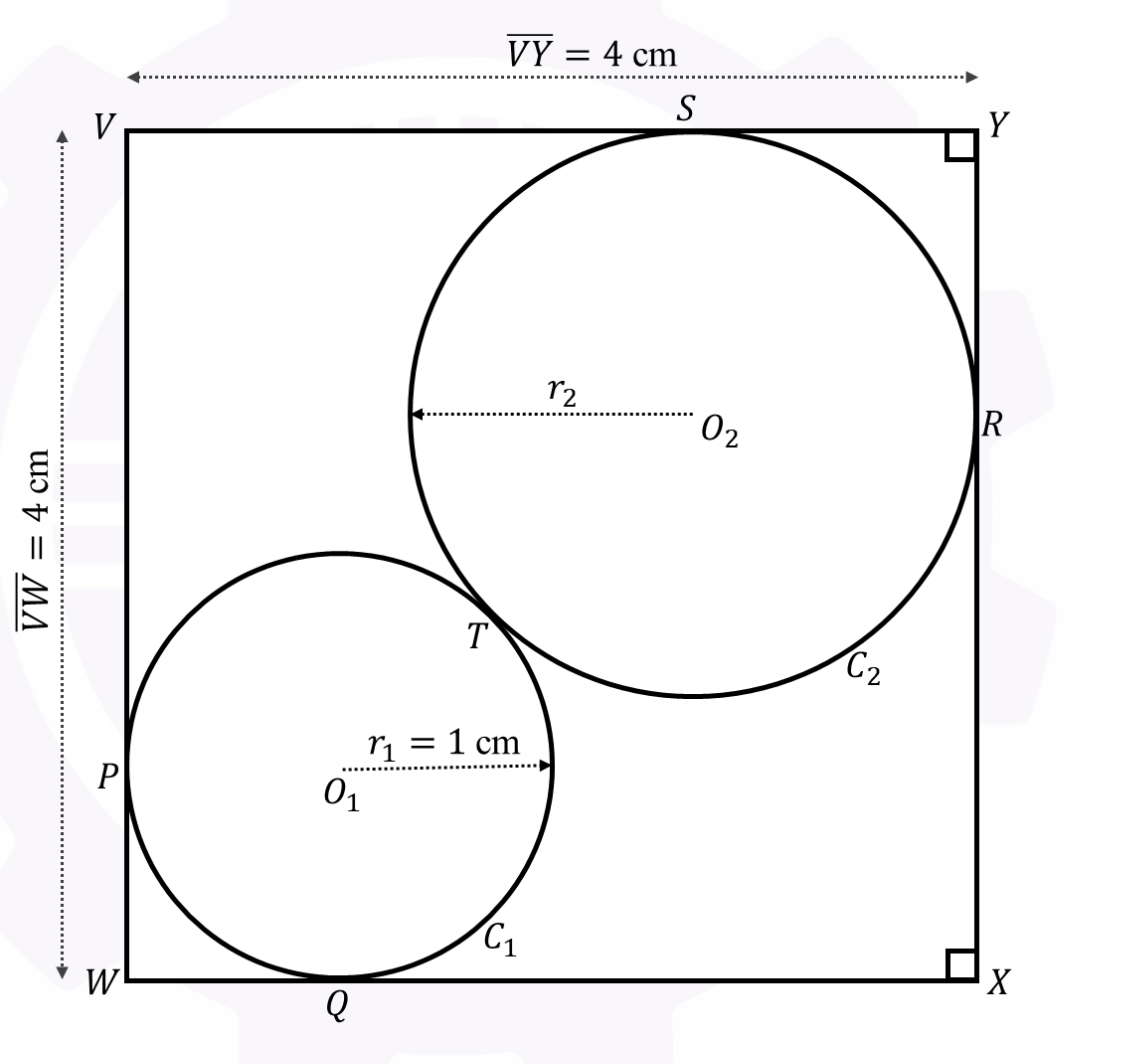
Question. Circle (center , radius ) touches square VWXY at points P and Q; circle (center , radius ) touches the square at points R and S. The two circles touch each other at T. Given and , find .
- (A)
- (B)
- (C)
- (D)
Solution
- — centers of the two circles
- — their radii (consistent length units)
-
Set up coordinates. Place the square so is at the origin. Reading off the figure, going around the square the corners are , , , — a square, since are two of its sides.
-
Place . sits in the corner, tangent to the two sides that meet there (, the left side , and , the bottom side ). A circle tangent to a line is at a distance equal to its radius from that line — so being tangent to both and pins its center at . With : .
-
Place . Same logic, opposite corner: sits in the corner, tangent to the top side () and the right side (). Being at distance from each pins its center at — in from each of those two sides.
-
Use the tangency condition between the circles. The two circles touch each other externally at (they're outside one another, just grazing at one point) — for two externally tangent circles, the distance between centers equals the sum of the radii:
This is the one geometric fact that turns the picture into an equation in (everything else is just substitution).
-
Write out the distance. Using the distance formula between and :
(both coordinate differences are the same, , because and sit symmetrically on the square's diagonal — so the two squared terms are identical, and simplifies to times that quantity.)
-
Set the two expressions for equal (step 4's requirement, using step 5's formula, with ):
-
Solve for . Expand the left side, then collect every term on one side:
-
Rationalize the denominator, so the answer matches the form of the options (no surd on the bottom). Multiply top and bottom by — chosen because collapses to a plain number, clearing the denominator:
So .
-
Sanity-check the number, not just the algebra: . That's positive (a radius has to be), and less than 3 cm (needed for step 5's to be positive, i.e. for to still be past along the diagonal) — both checks pass, so the answer is geometrically sensible, not just an artifact of the algebra.
Answer: (C)
BT Subject — one-mark MCQ (Q11–35)
Q11 — 1 mark, MCQ
Question. Consider the two functions and . Which of the following is the value of as ?
- (A) 0
- (B) 6
- (C) 8
- (D)
Solution
has a removable discontinuity at : factoring, for , so . is a polynomial (continuous everywhere), so . Sum of the limits: .
Answer: (B) 6
Q12 — 1 mark, MCQ
Question. Which of the following is one of the eigenvalues for the matrix given below?
- (A) 1
- (B) 3
- (C) 5
- (D) 7
Solution
- — the square matrix
- — an eigenvalue
- — the identity matrix of the same size as
Solve : .
Answer: (C) 5
Q13 — 1 mark, MCQ
Question. Which of the following functions has the highest area under the curve between and ?
- (A)
- (B)
- (C)
- (D)
Solution
Each area is : (A) gives ; (B) gives ; (C) gives ; (D) gives . (B) is largest.
Approximate syllabus mapping: the listed syllabus has no standalone "definite integration" line item, so this is filed under 1.2.1 (calculus) as the closest fit — flagging in case you'd rather leave it untagged.
Answer: (B)
Q14 — 1 mark, MCQ
Question. Cancer cells display a high level of heterogeneity in the expression of TP53 protein. Which of the following techniques can be directly used to determine the intra-tumoral heterogeneity of TP53 expression in a given tumor sample, without resorting to additional cell separation techniques?
- (A) Immunoblotting
- (B) Flow cytometry
- (C) ELISA
- (D) Quantitative RT-PCR
Solution
Immunoblotting, ELISA, and qRT-PCR all report a single bulk average across the whole sample, which by construction cannot reveal cell-to-cell heterogeneity. Flow cytometry measures TP53 signal in each dissociated single cell and reports the full distribution across the population — no upfront sorting/separation into subpopulations is needed to see that heterogeneity, since it shows up directly as a spread in the per-cell histogram.
Answer: (B) Flow cytometry
Q15 — 1 mark, MCQ
Question. The transfer function of a Proportional-Integral (PI) controller is given by , where is the controller gain, is the controller integral time constant, and is the Laplace variable. The role of the integral component of the controller is to ____.
- (A) integrate the difference between the process and manipulated variable
- (B) integrate the difference between the set point and disturbance variable
- (C) integrate the difference between the set point and the measured variable
- (D) integrate the difference between the input and output variable
Solution
- — controller gain
- — integral time constant ( or )
- — Laplace variable
A controller acts on the error signal, set point − measured (process) variable. The integral term in a PI controller accumulates (integrates) this error over time to drive out steady-state offset — that's specifically the set point vs. measured-variable difference, not the manipulated variable, disturbance, or a generic input/output pair.
Answer: (C)
Q16 — 1 mark, MCQ
Question. Which of the following enzymes is involved in the protection of cells from reactive oxygen species?
- (A) Hexokinase
- (B) Glucose 6-phosphate dehydrogenase
- (C) Enolase
- (D) Pyruvate kinase
Solution
Glucose-6-phosphate dehydrogenase (G6PD) is the committed, rate-limiting step of the pentose phosphate pathway, and its product is the NADPH used to regenerate reduced glutathione (GSH) — the cell's main buffer against reactive oxygen species. Hexokinase, enolase, and pyruvate kinase are glycolytic enzymes with no direct role in redox defense.
Answer: (B) Glucose 6-phosphate dehydrogenase
Q17 — 1 mark, MCQ
Question. In nitrogen fixation, to reduce nitrogen to ammonia, which one of the following shows the correct order of electron flow?
- (A) Ferredoxin → reductase → nitrogenase
- (B) NADH → reductase → nitrogenase
- (C) Ferredoxin → nitrogenase → reductase
- (D) Reductase → NADH → nitrogenase
Solution
In the nitrogenase complex, ferredoxin donates electrons to the Fe-protein (dinitrogenase reductase), which uses ATP hydrolysis to pass those electrons one at a time to the MoFe-protein (dinitrogenase, i.e. "nitrogenase" proper), which is where N₂ is actually reduced to ammonia. So the order is ferredoxin → reductase → nitrogenase.
Answer: (A)
Q18 — 1 mark, MCQ
Question. For monoclonal antibody production, hypoxanthine ____.
- (A) allows DNA synthesis in the absence of de novo dTMP synthesis
- (B) allows purine synthesis in cells containing HGPRT
- (C) induces cell fusion
- (D) prevents de novo nucleotide synthesis
Solution
Hybridoma selection uses HAT medium (hypoxanthine, aminopterin, thymidine). Aminopterin blocks de novo purine and thymidylate synthesis, so surviving cells must run the salvage pathway instead. Hypoxanthine feeds that salvage pathway specifically for purines, via HGPRT (hypoxanthine-guanine phosphoribosyltransferase) — myeloma fusion partners are chosen to be HGPRT-deficient, so only fused hybridomas (which inherit HGPRT from the B cell) can use hypoxanthine to survive. (A) describes thymidine's role in the same medium, not hypoxanthine's.
Answer: (B)
Q19 — 1 mark, MCQ
Question. Which one of the following proteins would elute third in gel filtration chromatography from a mixture of four proteins given below?
- (A) Insulin (6 kDa)
- (B) Myoglobin (17 kDa)
- (C) Thrombin (37 kDa)
- (D) Albumin (66 kDa)
Solution
In gel filtration (size-exclusion) chromatography, larger proteins are excluded from the pores of the resin and elute first, while smaller proteins get retained longer and elute last — the opposite order to molecular weight. Elution order here is Albumin (66 kDa, 1st) → Thrombin (37 kDa, 2nd) → Myoglobin (17 kDa, 3rd) → Insulin (6 kDa, 4th/last).
Answer: (B) Myoglobin (17 kDa)
Q20 — 1 mark, MCQ
Question. Which one of the following antibiotics blocks protein chain elongation by preventing the action of peptidyl transferase?
- (A) Bleomycin
- (B) Rifampicin
- (C) Chloramphenicol
- (D) Tetracycline
Solution
Chloramphenicol binds the 50S ribosomal subunit and directly inhibits peptidyl transferase, blocking peptide bond formation during elongation. Bleomycin damages DNA (not a translation inhibitor); rifampicin inhibits bacterial RNA polymerase (transcription, not translation); and tetracycline blocks aminoacyl-tRNA from binding the ribosomal A site — a different elongation-blocking mechanism, not peptidyl transferase inhibition.
Answer: (C) Chloramphenicol
Q21 — 1 mark, MCQ
Question. The catalytic efficiency of an enzyme following Michaelis-Menten kinetics is defined by ____.
- (A)
- (B)
- (C)
- (D)
Solution
- — turnover number ()
- — Michaelis constant ()
Catalytic efficiency is the standard Michaelis-Menten figure of merit for how effectively an enzyme converts substrate at low (non-saturating) concentration, defined as — alone just measures turnover rate at saturation, without accounting for how tightly the enzyme binds substrate ().
Answer: (C)
Q22 — 1 mark, MCQ
Question. The RNA primer synthesized during bacterial DNA replication is removed by ____.
- (A) DNA gyrase
- (B) DNA Polymerase I
- (C) Primase
- (D) DNA Polymerase III
Solution
Primase (C) lays down the RNA primer, and DNA Polymerase III (D) extends it into new DNA — neither removes it. DNA gyrase (A) relieves supercoiling ahead of the replication fork. DNA Polymerase I carries a 5'→3' exonuclease activity that excises the RNA primer and then fills the resulting gap with DNA, before DNA ligase seals the nick.
Answer: (B) DNA Polymerase I
Q23 — 1 mark, MCQ
Question. Match the carbohydrates in Column I with the correct glycosidic linkages involved in Column II.
| Column I | Column II |
|---|---|
| P. Amylose | 1. β(1→4) |
| Q. Sucrose | 2. α(1→4) |
| R. Amylopectin | 3. α1→β2 |
| S. Cellulose | 4. α(1→4), α(1→6) |
- (A) P-4; Q-3; R-2; S-1
- (B) P-2; Q-1; R-4; S-3
- (C) P-2; Q-3; R-4; S-1
- (D) P-1; Q-3; R-4; S-2
Solution
Amylose is a linear glucose polymer joined entirely by α(1→4) bonds → 2. Amylopectin is the branched form of starch: α(1→4) along each chain plus α(1→6) at branch points → 4. Cellulose is a linear glucose polymer joined by β(1→4) bonds → 1. Sucrose is glucose linked to fructose through their anomeric carbons, an α1→β2 glycosidic bond → 3. So P-2; Q-3; R-4; S-1.
Answer: (C)
Q24 — 1 mark, MCQ
Question. The correct sequence of the four steps involved in anaerobic production of biogas from complex organics is:
- (A) Hydrolysis → Acidogenesis → Acetogenesis → Methanogenesis
- (B) Methanogenesis → Acetogenesis → Acidogenesis → Hydrolysis
- (C) Acidogenesis → Hydrolysis → Methanogenesis → Acetogenesis
- (D) Hydrolysis → Methanogenesis → Acidogenesis → Acetogenesis
Solution
Anaerobic digestion breaks complex organics down in stages: hydrolysis first splits polymers (carbohydrates, proteins, lipids) into soluble monomers; acidogenesis ferments those into volatile fatty acids, alcohols, CO₂, and H₂; acetogenesis converts those products into acetate, CO₂, and H₂; methanogenesis then converts the acetate/CO₂/H₂ pool into methane — necessarily last, since it consumes the products of the stage before it.
Answer: (A)
Q25 — 1 mark, MCQ
Question. Which one of the following options represents the products of light reactions of photosynthesis in plants?
- (A) O₂/NADH/H₂
- (B) O₂/NADP⁺/CO₂
- (C) O₂/NADPH/ATP
- (D) O₂/NADP⁺/ATP
Solution
The light reactions split water (releasing O₂), and use that electron flow plus the proton gradient to generate both ATP (via photophosphorylation) and NADPH (via reduction of NADP⁺ at the end of the electron transport chain) — both feed the Calvin cycle. CO₂ is a Calvin cycle input, not a light-reaction product, and NADH (not NADPH) is the respiratory carrier, ruling out (A), (B), and (D).
Answer: (C) O₂/NADPH/ATP
Q26 — 1 mark, MCQ
Question. Which component of the CRISPR/Cas9 gene editing system is NOT of natural origin?
- (A) Cas9 protein
- (B) CRISPR repeats
- (C) PAM sequence
- (D) sgRNA
Solution
Cas9 protein, CRISPR repeats, and the PAM sequence are all native to the bacterial/archaeal CRISPR immune system. The single guide RNA (sgRNA) is a laboratory construct: it's an engineered fusion of the natural crRNA and tracrRNA into one chimeric molecule, built specifically to simplify Cas9 targeting for genome editing — it doesn't exist as such in nature.
Answer: (D) sgRNA
BT Subject — one-mark MSQ (Q27–30)
Q27 — 1 mark, MSQ
Question. The equation has a solution of the form . The value(s) of satisfying this is/are:
- (A) 0
- (B) 1
- (C) -1
- (D)
Solution
- — constant coefficients of the ODE
- — a root of the characteristic equation (an exponent of a valid solution)
Substituting gives . Both roots are valid — this is a second-order linear ODE with constant coefficients, and its characteristic equation has two real roots, each giving a valid exponential solution.
Answer: (B) 1 and (C) -1
Q28 — 1 mark, MSQ
Question. Which of the following drugs inhibit(s) ATP-ADP translocase?
- (A) Oligomycin
- (B) Atractyloside
- (C) Amytal
- (D) Bongkrekic acid
Solution
ATP-ADP translocase (the adenine nucleotide translocator, ANT) shuttles ADP into and ATP out of the mitochondrial matrix. Atractyloside blocks it by locking it in the cytosol-facing conformation, and bongkrekic acid blocks it by locking it in the matrix-facing conformation instead — both are classic, textbook ANT inhibitors. Oligomycin acts elsewhere, on the subunit of ATP synthase; amytal blocks Complex I of the electron transport chain. Neither touches the translocase itself.
Answer: (B) Atractyloside and (D) Bongkrekic acid
Q29 — 1 mark, MSQ
Question. Which of the following is/are extra-cellular matrix protein(s)?
- (A) Myosin
- (B) Fibronectin
- (C) Lamin
- (D) Collagen
Solution
Fibronectin and collagen are both secreted structural components of the extracellular matrix. Myosin is an intracellular motor protein (cytoskeletal, not secreted), and lamin is a structural protein of the nuclear lamina, inside the cell — neither is part of the ECM.
Answer: (B) Fibronectin and (D) Collagen
Q30 — 1 mark, MSQ
Question. BLAST and its extensions can be used to determine similarity of a query protein sequence with which of the following database(s)?
- (A) A database of translated nucleotide sequences
- (B) A database of binding ligands and small translated peptides
- (C) A database of protein structures
- (D) A database of binding, linking and self-assembling proteins
Solution
A protein query can be searched with tblastn against a database of
translated nucleotide sequences (A) — this is a standard BLAST extension,
and it's the only option that names a real BLAST-searchable database type.
(B), (C), and (D) don't correspond to standard BLAST targets — a protein
structure database (C) is searched by structural-alignment tools (e.g.
DALI), not BLAST's sequence-comparison model, even though the PDB's
sequences are themselves BLAST-searchable via pdbaa.
Answer: (A)
BT Subject — one-mark NAT (Q31–35)
Q31 — 1 mark, NAT
Question. The mean of the following series is ____. (rounded off to three decimal places)
Solution
- — first term of the series
- — last term of the series
This is an arithmetic series (step 0.01, from 0.01 to 1.00 — 100 terms). For an arithmetic series, the mean equals the average of the first and last terms: .
Answer: 0.505
Q32 — 1 mark, NAT
Question. You are characterizing a new enzyme isolated and purified in the laboratory. If the maximum velocity of the enzyme is and the total concentration of the enzyme in the reaction mixture is , then the turnover number of the enzyme is ____ s⁻¹. (answer in integer)
Solution
- — maximum reaction velocity
- — total enzyme concentration
Turnover number . Converting to per-second: .
Answer: 20
Q33 — 1 mark, NAT
Question. To determine the viable cell count of a bacterial culture, you have plated of a 100-fold diluted sample of the culture on a nutrient agar plate and obtained 20 colonies after overnight incubation. The viable cell count of the culture is ____ CFU mL⁻¹. (answer in integer)
Solution
- — reciprocal of the dilution fraction (e.g. 100 for a 100-fold dilution)
Colony count in the plated volume gives the diluted sample's concentration first: in the diluted sample. Since the sample was diluted 100-fold before plating, the original culture's concentration is 100× that: .
Answer: 40000
Q34 — 1 mark, NAT
Question. Given below is the Gibbs free energy change (ΔG) in kilo Joules per electron equivalent (kJ e⁻eq⁻¹) at pH 7.0, of organic and inorganic half reactions.
Acetate synthesis:
Reduction reaction:
The free energy change of acetate oxidation to CO₂, H₂O and HCO₃⁻ is ____ kJ e⁻eq⁻¹. (rounded off to two decimal places)
Solution
- — the electron-donor half-reaction, written as an oxidation
- — the electron-acceptor half-reaction, written as a reduction
This is asking for a full aerobic oxidation reaction, so it needs both half-reactions combined, not just the acetate one on its own — that's why the O₂ half-reaction is given at all.
-
Acetate is the electron donor, and it's being oxidized — the reverse of the given "acetate synthesis" (reduction) half-reaction. Reversing a half-reaction flips the sign of its ΔG:
-
O₂ is the electron acceptor, and it's being reduced — exactly as given, no sign flip needed:
-
Combine the two per-electron-equivalent half-reactions into the overall reaction. Because both are already normalized to one electron equivalent, the overall reaction's free energy is simply their sum (the electron donor supplies the electron, the acceptor consumes it — add the two ΔG's to get the net driving force of the coupled redox reaction):
Answer: -106.12
Q35 — 1 mark, NAT
Question. You have purified an enzyme using a series of chromatographic methods. It was observed that a of this purified enzyme converted 10 mM substrate per hour at 25°C and pH 7. Its specific activity is ____ IU . (rounded off to three decimal places)
Solution
- — international unit, 1 µmol of substrate converted per minute
Working per mL: the reaction rate is (since 1 mM = 1 µmol/mL), which is (1 IU = 1 µmol/min). Specific activity is activity per unit mass of enzyme: .
Answer: 0.017
BT Subject — two-mark MCQ (Q36–40)
Q36 — 2 marks, MCQ
Question. In the open-loop process shown in the figure, the input , the transfer function and the output are given in the Laplace domain in terms of the Laplace variable . For this process, which of the following is true? (where are the magnitude of the input, the characteristic time, and the gain for the process, respectively)
- (A)
- (B)
- (C)
- (D)
Solution
- — step input magnitude
- — process gain
- — process time constant
. This is exactly times the standard first-order step response , whose inverse Laplace transform is . So — the step magnitude scales the whole response, it doesn't sit inside the exponential.
Answer: (B)
Q37 — 2 marks, MCQ
Question. Match the immunological terms in Column I with their function/description in Column II.
| Column I | Column II |
|---|---|
| P. J gene | 1. Suppresses immune system by blocking calcineurin |
| Q. Cyclosporin | 2. Antibody binding site on a large molecule |
| R. Epitope | 3. Small foreign molecule which elicits an immune response only when combined with a carrier molecule |
| S. Hapten | 4. Contributes to antibody diversity |
- (A) P-3; Q-4; R-2; S-1
- (B) P-2; Q-4; R-1; S-3
- (C) P-4; Q-1; R-2; S-3
- (D) P-1; Q-3; R-4; S-2
Solution
The J (joining) gene segment is one of the V(D)J recombination building blocks that generates antibody diversity → 4. Cyclosporin is an immunosuppressant that works by blocking calcineurin, which normally activates T cells → 1. An epitope is the specific site on a (large) antigen that an antibody binds → 2. A hapten is a small molecule that's only immunogenic once attached to a larger carrier → 3. So P-4; Q-1; R-2; S-3.
Answer: (C)
Q38 — 2 marks, MCQ
Question. Match the genetic disorders in Column I to the corresponding underlying cause in Column II.
| Column I | Column II |
|---|---|
| P. Klinefelter Syndrome | 1. X-chromosome insufficiency |
| Q. Turner syndrome | 2. DNA helicase mutations |
| R. Bloom syndrome | 3. Nucleotide excision repair defects |
| S. Xeroderma pigmentosum | 4. Extra X chromosome(s) in a male |
- (A) P-1; Q-3; R-4; S-2
- (B) P-4; Q-1; R-2; S-3
- (C) P-4; Q-2; R-3; S-1
- (D) P-3; Q-2; R-4; S-1
Solution
Klinefelter syndrome is caused by an extra X chromosome in a male (typically XXY) → 4. Turner syndrome is monosomy X (a single X, i.e. X-chromosome insufficiency) → 1. Bloom syndrome is caused by mutations in BLM, a RecQ-family DNA helicase → 2. Xeroderma pigmentosum is a defect in nucleotide excision repair → 3. So P-4; Q-1; R-2; S-3.
Answer: (B)
Q39 — 2 marks, MCQ
Question. Match the biomolecules in Column I with their function given in Column II.
| Column I | Column II |
|---|---|
| P. Lectins | 1. Acts as ATP dependent pump to efflux out small molecules |
| Q. P-glycoprotein | 2. Targets lysosomal enzymes to their destination |
| R. Digitoxigenin | 3. Specific carbohydrate binding proteins |
| S. Mannose 6-phosphate | 4. Inhibits Na⁺-K⁺ pump |
- (A) P-3; Q-2; R-1; S-4
- (B) P-1; Q-3; R-4; S-2
- (C) P-2; Q-1; R-3; S-4
- (D) P-3; Q-1; R-4; S-2
Solution
Lectins are carbohydrate-binding proteins → 3. P-glycoprotein is an ATP-dependent efflux pump (the multidrug-resistance transporter) →
- Digitoxigenin is a cardiac glycoside that inhibits the Na⁺/K⁺-ATPase → 4. Mannose-6-phosphate is the tag that routes lysosomal enzymes to the lysosome → 2. So P-3; Q-1; R-4; S-2.
Answer: (D)
Q40 — 2 marks, MCQ
Question. By elemental analysis of a biomass sample, it was found that the cells in the given sample are composed of (by weight) C=50%, H=8%, O=20%, N=10%, and ash content=12%. Which of the following is the correct empirical formula of the ash-free cells, normalized with respect to Nitrogen?
- (A)
- (B)
- (C)
- (D)
Solution
- — moles of element per basis mass
- — moles of the element chosen to normalize against (usually N)
Per 100 g of biomass, the ash-free portion is C:50g, H:8g, O:20g, N:10g (these already sum to 88g, consistent with 12% ash separately). Converting to moles (, , , ): C: , H: , O: , N: . Dividing every value by the N moles (0.714) to normalize to N=1: C: , H: , O: .
Answer: (A)
BT Subject — two-mark MSQ (Q41–50)
Q41 — 2 marks, MSQ
Question. For the given matrix, which of the statements given below is/are true?
- (A) The matrix is full rank
- (B) The matrix is invertible
- (C) The matrix has a determinant
- (D) The matrix has a transpose
Solution
- — matrix entries, read row by row
Compute the determinant by cofactor expansion along the first row: . The determinant is 0, so the matrix is singular — not full rank and not invertible, ruling out (A) and (B). But (C) and (D) are trivially true of any square matrix, regardless of whether it happens to be singular: every matrix has a determinant (even when that value is zero), and every matrix has a transpose.
Answer: (C) and (D)
Q42 — 2 marks, MSQ
Question. Messenger RNAs (mRNAs) translate to generate polypeptides and the translation terminates at the UGA, UAG or UAA stop codons. The AGA codon acts as additional stop codon in the mitochondria. The longest possible polypeptide(s) that can be hypothetically translated in the cytosol and/or mitochondria, from the given full length mRNA sequence (36 nucleotides) is/are:
- (A) 7 amino acids long in the cytosol
- (B) 5 amino acids long in the mitochondria
- (C) 6 amino acids long in the mitochondria
- (D) 8 amino acids long in the cytosol
Solution
There are two in-frame AUG codons here, in different reading frames, so each needs to be checked separately as a possible start:
-
Start at position 7 (
AUG-ACC-CAU-GUG-GCG-AGA-CGG-UAG): in the cytosol, AGA just codes Arg (not a stop there), so translation runs all the way to the UAG stop — Met-Thr-His-Val-Ala-Arg-Arg, 7 amino acids. In the mitochondria, AGA is a stop, so this same start only reaches Met-Thr-His-Val-Ala before terminating — 5 amino acids. That's a valid mitochondrial product, but not the longest one available (see next). -
Start at position 14 (
AUG-UGG-CGA-GAC-GGU-AGU-UAA): this reading frame never hits an AGA codon at all (noteCGAandAGUare notAGA), so it runs to the universal UAA stop in both compartments — Met-Trp-Arg-Asp-Gly-Ser, 6 amino acids, identically in cytosol and mitochondria.
The question asks for the longest possible polypeptide in each compartment. In the cytosol, that's the 7-aa product from start 1 (A) — longer than the 6-aa alternative from start 2. In the mitochondria, the AGA-truncated 5-aa product from start 1 is not the longest available, because start 2 avoids the AGA stop entirely and reaches 6 amino acids instead (C) — so (B) describes a real but non-maximal product, and isn't selected.
Answer: (A) and (C)
Q43 — 2 marks, MSQ
Question. The RNA sequence below depicts the part of a 330 nucleotides long mRNA and it encodes the C-terminal portion of a protein.
A mutation was identified in this RNA denoted as 322A→U. This nucleotide change is represented by which of the following class(es) of mutation?
- (A) Missense mutation
- (B) Non-sense mutation
- (C) Transversion mutation
- (D) Silent mutation
Solution
The shown 30-nucleotide fragment is the last 30 bases of a 330-base
message, so it spans positions 301–330. Position 322 is the 22nd base of
this fragment, which falls on the first base of the 8th codon: AGA
(coding Arg). The mutation changes this to UGA — a stop codon. Turning a
sense codon into a stop codon mid-message is, by definition, a nonsense
mutation (B). Separately, classifying the substitution itself: A is a
purine and U is a pyrimidine, so a purine→pyrimidine change is a
transversion (C), not a transition (which would be purine→purine or
pyrimidine→pyrimidine).
Answer: (B) and (C)
Q44 — 2 marks, MSQ
Question. A microbial culture is being grown in a bioreactor with continuous aeration. The dissolved oxygen probe provided with the system shows a reading of zero. In this context, which of the following inferences is/are correct?
- (A) The culture has died due to absence of oxygen
- (B) The culture has run out of carbon source
- (C) The culture growth becomes oxygen limited
- (D) The culture growth is independent of dissolved oxygen
Solution
A DO reading of zero under continuous aeration means oxygen is being consumed as fast as (or faster than) it's being supplied — the oxygen transfer rate can't keep up with the culture's oxygen uptake rate, so growth becomes oxygen-transfer-limited (C). It says nothing about the culture being dead (A — cells can grow perfectly well right up to the point oxygen becomes limiting, that's the definition of the limitation), nothing about carbon source (B — an unrelated, unsupported inference), and directly contradicts (D).
Answer: (C)
Q45 — 2 marks, MSQ
Question. For a Newtonian fluid, a plot of shear stress (on Y axis) against shear rate (on X axis) will result in a straight line ____.
- (A) parallel to the X axis
- (B) parallel to the Y axis
- (C) with a negative slope
- (D) with a positive slope
Solution
- — shear stress
- — viscosity
- — shear rate
A Newtonian fluid is defined by — shear stress is directly proportional to shear rate, with viscosity (always positive) as the constant of proportionality. That's a straight line through the origin with slope .
Answer: (D)
Approximate syllabus mapping: the listed syllabus has no dedicated fluid mechanics/rheology line item, so this and Q47 are filed under 4.1.10 (reactor design/scale-up, which rheology directly feeds into) as the closest fit.
Q46 — 2 marks, MSQ
Question. In an aerobic fermentation with air sparging, which of the following options can be used to increase the volumetric mass transfer coefficient for oxygen transfer?
- (A) Using pure oxygen in place of air
- (B) Increasing the volumetric flow rate of air
- (C) Reducing the bubble diameter
- (D) Decreasing the agitation rate
Solution
is a physical/hydrodynamic property of the gas-liquid system — how much interfacial area is available and how fast oxygen crosses it — not a statement about the driving force. Switching to pure oxygen (A) increases the concentration gradient (raises ), which increases the actual oxygen transfer rate, but doesn't change itself, so it's excluded here. Increasing air flow rate (B) raises gas holdup and turbulence, increasing interfacial area . Reducing bubble diameter (C) directly increases interfacial area per unit volume (). Decreasing agitation (D) reduces turbulence and bubble breakup, decreasing — the opposite of what's asked.
Answer: (B) and (C)
Q47 — 2 marks, MSQ
Question. For a liquid flowing in a circular cross section pipe, the transition from laminar to turbulent flow will NOT depend on which of the following factor(s)?
- (A) The diameter of the pipe
- (B) The length of the pipe
- (C) The linear velocity of the liquid
- (D) The viscosity of the liquid
Solution
- — fluid density
- — velocity
- — pipe diameter
- — viscosity
The laminar–turbulent transition is governed entirely by the Reynolds number, — density, velocity, diameter, and viscosity. Pipe length doesn't appear anywhere in that expression: a longer or shorter pipe carrying the same fluid at the same velocity and diameter transitions at the same , so length is the one factor that doesn't matter.
Answer: (B)
Q48 — 2 marks, MSQ
Question. Which of the following is/are posttranslational modification(s) involved in epigenetic control of gene expression?
- (A) Arginine methylation
- (B) Lysine acetylation
- (C) Cytosine methylation
- (D) Cytosine deamination
Solution
Arginine methylation and lysine acetylation are both classic histone post-translational modifications — protein modifications made after translation, which is specifically what the question asks for. Cytosine methylation (C) is a genuine epigenetic mechanism, but it's a direct modification of the DNA base itself, not a protein — not a "posttranslational" modification at all. Cytosine deamination (D) is a DNA-damage/mutagenic event, not a regulated epigenetic mark.
Answer: (A) and (B)
Q49 — 2 marks, MSQ
Question. For an ideal plug flow reactor, which of the following statements is/are true?
- (A) It can be approximated by a large number of ideal continuous stirred tank reactors connected in series
- (B) It has significant back mixing
- (C) It has significant axial mixing
- (D) It has a uniform velocity profile across any cross section
Solution
An ideal PFR has, by definition, no back-mixing and no axial dispersion — ruling out (B) and (C) directly. It does have a flat ("plug") velocity profile across every cross-section, by definition (D). And a classic, textbook result is that a PFR is the limiting case of an infinite number of ideal CSTRs connected in series — so a large number of CSTRs-in-series is a standard way to approximate one (A).
Answer: (A) and (D)
Q50 — 2 marks, MSQ
Question. An enzyme-catalyzed reaction is found to have . Which of the following statements about this reaction is/are true?
- (A) The rate of the reaction cannot be predicted
- (B) The rate of the reaction is high
- (C) The rate of the reaction is low
- (D) The reaction is irreversible
Solution
- — standard Gibbs free energy change
- — gas constant
- — absolute temperature
is a thermodynamic quantity — it tells you the direction and extent of a reaction at equilibrium, not how fast it gets there. Rate is governed by kinetics (activation energy, ), which says nothing about directly — a highly favorable reaction can still be kinetically slow (that's exactly why cells need enzymes at all). So (A) is correct, and (B)/(C) are both unjustified guesses in either direction. Separately, : for at room temperature, is astronomically large, meaning the reverse reaction is negligible — thermodynamically, that's effectively irreversible (D), even though nothing here says anything about its rate.
Answer: (A) and (D)
BT Subject — two-mark NAT (Q51–65)
Q51 — 2 marks, NAT
Question. Consider the equation . The value of the integral using the trapezoidal method and interval is ________. (rounded off to two decimal places)
Solution
- — step size between points
- — equally spaced points from to
Since , the integral is really , approximated numerically with 4 trapezoidal strips (, points ):
| 1 | 1.25 | 1.5 | 1.75 | 2 | |
|---|---|---|---|---|---|
| 1 | 0.8 | 0.6667 | 0.5714 | 0.5 |
(Sanity check: the exact value is — trapezoidal over-estimates slightly here because is convex, which matches.)
Answer: 0.70
Q52 — 2 marks, NAT
Question. If the straight lines given by the following two equations are parallel to each other, the value of is ____. (answer in integer)
Solution
- — coefficients of the first line
- — coefficients of the second line
Two lines and are parallel exactly when their coefficients are proportional: . Here:
Answer: 8
Q53 — 2 marks, NAT
Question. A straight line intersects a circle with center at and radius of magnitude 1 at two points. The length of the chord formed by this intersection is ________. (rounded off to three decimal places)
Solution
- — circle center
- — circle radius
The circle is . Substituting and letting :
giving (so ) and (so ) — the two intersection points are and . The chord length is the distance between them:
Answer: 1.414
Approximate syllabus mapping: this and Q52 are pure coordinate-geometry questions with no dedicated syllabus line item — filed under 1.1.2 (systems of linear equations) as the closest fit, since solving them comes down to solving a system.
Q54 — 2 marks, NAT
Question. A heat exchanger during operation in a bioprocess has a steady temperature of 90°C. After completion of its operation, it was shut down and it was observed that the rate of decrease of temperature at any time was directly proportional to the difference , where denotes temperature at time . It was observed that it took 30 min for the temperature to drop to 70°C. The temperature after 51.5 min will be ________ °C. (rounded off to the nearest integer)
Solution
- — ambient/final temperature
- — initial temperature
- — cooling rate constant
This is Newton's law of cooling: , giving with .
-
Find from the given data point ( at ):
-
Evaluate at min:
Answer: 60
Q55 — 2 marks, NAT
Question. A microbial culture (following Monod model for growth) has a maximum specific growth rate of , Monod constant of and endogenous decay rate of . At limiting substrate concentration of , the net specific growth rate will be ________ day⁻¹. (rounded off to one decimal place)
Solution
- — maximum specific growth rate
- — Monod (half-saturation) constant
- — limiting substrate concentration
- — endogenous decay rate
Net specific growth rate accounts for endogenous decay: . Everything needs to be in the same time base (days) before combining terms:
- Convert to day⁻¹: .
- Evaluate the Monod term, with and (converting to the same units as ): ( here, so the culture is essentially at .)
- Subtract decay: .
Answer: 2.3
Q56 — 2 marks, NAT
Question. A CSTR with a volume of is operated in cell recycle mode. At a volumetric flow rate of and effluent biomass of , the steady state biomass concentration is . The mean cell retention time in the reactor is ____ days. (answer in integer)
Solution
- — reactor volume
- — in-reactor biomass concentration
- — flow rate of the stream leaving the system
- — biomass concentration in that leaving stream
Mean cell retention time (MCRT, ) is cells held in the system divided by the rate cells leave it: , where is the in-reactor biomass concentration and is the concentration in the stream actually leaving the system.
Answer: 100
Q57 — 2 marks, NAT
Question. The electron equivalent per liter (e⁻eq L⁻¹) of acetate ion solution of concentration is ________ e⁻eq L⁻¹. (rounded off to one decimal place)
Solution
- — number of carbon, hydrogen, oxygen atoms per molecule
- — electron equivalents per mole
- Molar mass of acetate ion (C₂H₃O₂⁻): .
- Molar concentration: .
- Electron equivalents per mole. Full combustion of one mole of acetate/acetic acid consumes 2 mol O₂ (C₂H₄O₂ + 2O₂ → 2CO₂ + 2H₂O), and each mole of O₂ accepts 4 electrons () — so acetate carries electron equivalents per mole.
- Combine: .
Answer: 1.4
Approximate syllabus mapping: no dedicated "electron equivalents / degree of reduction" line item exists in the syllabus — filed under 4.1.6 as the closest fit, since this is the stoichiometric machinery behind growth/substrate balances.
Q58 — 2 marks, NAT
Question. From the following plot of versus (a straight line running from to ), and if , the value of is ________. (rounded off to one decimal place)
Solution
The plotted line runs from to , i.e. slope 1 and intercept 1, so . Integrating:
Use to find : . Then:
Answer: 8.5
Q59 — 2 marks, NAT
Question. A batch sterilizer is being operated at 121°C for sterilizing a medium containing microbial cells. Assume that the thermal deactivation of cells is a first order process with a death rate constant of at 121°C. If the initial concentration of microbes in the medium is , the time taken to reduce the microbial load to a final concentration of is ________ min. (rounded off to the nearest integer)
Solution
- — initial viable count
- — death rate constant
- — time
First-order thermal death: .
Answer: 30
Q60 — 2 marks, NAT
Question. A substrate is consumed in a zero order reaction such that its concentration falls from to in 4 hours. The total time taken for complete utilization of substrate will be ________ hours. (answer in integer)
Solution
- — initial concentration
- — zero-order rate constant
Zero-order kinetics: concentration falls linearly, . From the given data, the rate constant is . "Complete utilization" means starting from :
Answer: 6
Q61 — 2 marks, NAT
Question. A microbe that follows Monod growth kinetics on a limiting substrate (maximum specific growth rate of and Monod constant of ) is cultivated in a continuous reactor for microbial growth (chemostat) with sterile feed. Given that the chemostat volume is 5 L and inlet concentration of limiting substrate is , the minimum inlet feed flow rate for chemostat washout is ______ L h⁻¹. (rounded off to one decimal place)
Solution
- — critical (washout) dilution rate
- — feed substrate concentration
At steady state , and can rise at most to the feed concentration (as ). So washout happens once the dilution rate reaches the maximum growth rate achievable at :
(with , the Monod term is essentially 1). The minimum feed flow rate for washout is then:
Answer: 2.5
Q62 — 2 marks, NAT
Question. It is desired to cultivate 150 mg (dry weight) microbial cells with an empirical formula of C₅H₇O₂N. If the phosphorus requirement for the cells is 20% of the nitrogen requirement (on a weight/weight basis), the minimum amount of phosphorous required to be added to the cultivation medium is ________ mg. (rounded off to one decimal place)
Solution
- Molar mass of C₅H₇O₂N: .
- Nitrogen's mass fraction in the cells: (12.39%).
- Nitrogen needed for 150 mg cells: .
- Phosphorus needed, at 20% of the N requirement:
Answer: 3.7
Q63 — 2 marks, NAT
Question. In the process of generating a clonal mammalian cell line, a single cell was seeded in a well of a cell culture plate. After the first 48 hours, one of the progeny cells underwent apoptosis due to a new mutation. If the doubling time of the cells is 24 hours and no more cell death occurs, the total number of cells after a total of 7 days from seeding will be ______. (answer in integer)
Solution
- — starting cell number
- — doubling time
Track the population by doubling time (24 h):
- : 1 cell
- h: 2 cells
- h: 4 cells, then one dies → 3 cells (the "after the first 48 hours" apoptosis)
From here, no more death — the population of 3 just keeps doubling every 24 h. From h to h (7 days) is more doublings:
Answer: 96
Q64 — 2 marks, NAT
Question. A disease-associated allele shows X-linked recessive inheritance. If the mother is a carrier of the disease, the father is genetically normal and the child born is a son, then the probability that he is born with the disease is ________. (rounded off to one decimal place)
Solution
A son gets his single X chromosome from his mother (his Y comes from his father, so the father's genotype is irrelevant to an X-linked trait in a son). The mother is a carrier — one normal X, one disease-allele X — so she passes the disease allele to any given son with probability .
Answer: 0.5
Q65 — 2 marks, NAT
Question. A packed bed bioreactor with length 1 m and inside diameter 10 cm has liquid flowing at an interstitial velocity of . Given a volumetric flow rate of , the void fraction of the packed bed is ________. (rounded off to two decimal places)
Solution
- — bed void fraction
- — volumetric flow rate
- — empty-column cross-sectional area
The superficial velocity is the flow rate divided by the full (empty-column) cross-sectional area — the void fraction is what relates it to the interstitial velocity (the actual, faster velocity through the pores): .
- Cross-sectional area (diameter 10 cm, radius 5 cm): .
- Superficial velocity: (converting ).
- Solve for :
Answer: 0.32
Approximate syllabus mapping: filed under 4.1.5 (immobilized-enzyme reactor design, the classic packed-bed context) as the closest fit — the question itself is generic fluid-mechanics-through-a-packed-bed, which has no dedicated line item.