Recycle, Purge, and Bypass
Recycle, purge, and bypass streams
Recycle, bypass, and purge are three ways a stream can be routed around or through a process unit, each solving a different problem: recycle raises conversion, bypass controls product concentration or temperature, and purge prevents build-up of unwanted material.
Recycle
Recycle takes part of the product stream and routes it back to combine with the fresh feed at the process inlet.
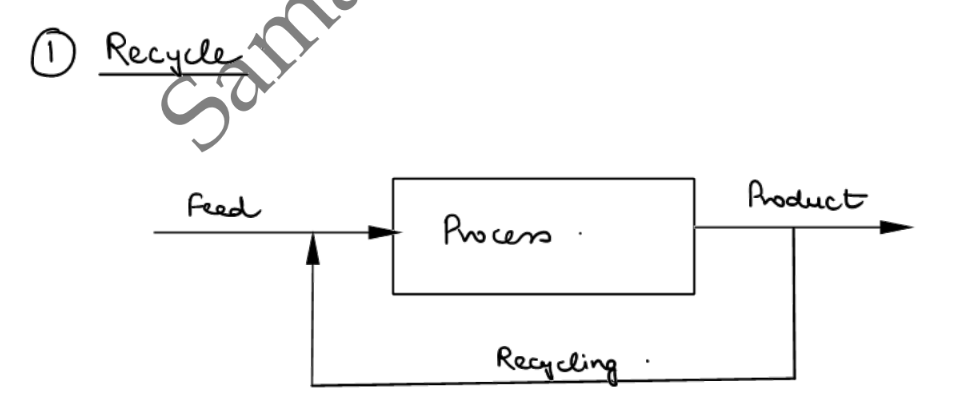
Reasons to recycle:
- Increase residence time.
- Increase overall conversion.
- But: may reduce productivity beyond a point.
Recycle raises overall conversion (of the fresh feed, across the whole recycle loop) — it does not necessarily raise single-pass conversion (reactor inlet to outlet, one pass). Diluting the reactor's inlet with partially-converted recycle material typically lowers single-pass conversion; as the recycle ratio grows large, per-pass performance approaches that of a CSTR (the lowest per-pass conversion for a given volume), even as overall conversion of fresh feed climbs.
Dilution rate, HRT, and washout
A chemostat is a continuous bioreactor: fresh medium flows in and an equal volume of liquid (with whatever cells are suspended in it) flows out, continuously, keeping the reactor volume constant.
- — dilution rate (how fast the reactor volume is being flushed and replaced with fresh feed),
- — feed flow rate,
- — reactor (working) volume,
- — hydraulic retention time (average time a parcel of liquid spends in the reactor before it flows out — pure plumbing, no biology involved),
In a normal chemostat (no recycle), cells are just suspended in that liquid and leave with it at the same rate, so biomass residence time equals HRT — cells are being physically flushed out at rate regardless of how fast they grow.
For the population to survive, cells must regrow at least as fast as they're flushed out. Growth rate is capped at (the fastest that organism can divide, under ideal conditions), so:
- : cells regrow faster than they're flushed out — population reaches steady state.
- : cells are flushed out faster than they can replace themselves — the population shrinks toward zero. This is washout: the reactor empties itself of cells even though liquid keeps flowing through normally.
Cell recycle and washout
Cell recycle separates cells out of a bioreactor's outflow (settler, centrifuge, or membrane) and pumps them back into the tank, so only cell-free liquid actually leaves — like a sieve that catches marbles while water drains straight through.
Cell recycle decouples the two residence times a simple chemostat locks together:
- Hydraulic retention time (HRT) — unchanged, since it's set by the liquid flow rate alone.
- Biomass residence time — stretched out, because the separator returns cells instead of letting them leave with the liquid.
Because cells are held back rather than washed out with the liquid, the effective rate at which cells actually exit the system is much lower than — set by how good the separator is, not by the liquid flow rate. So the reactor can run at a dilution rate above without washing out. The better the separator concentrates cells back into the recycle stream, the further above the flow rate can go before washout.
Worked example: does cell recycle prevent washout above ?
Question. True or false: cell recycle uncouples the hydraulic retention time from the biomass residence time, enabling operation at dilution rates higher than without washout.
Solution.
- Without recycle, HRT and biomass residence time are the same thing (cells leave with the liquid at rate ), so washout is unavoidable once .
- With recycle, the separator returns cells to the tank, so HRT stays (liquid-only) while biomass residence time stretches out — the two are no longer equal.
- Because cells are no longer actually leaving at rate , the reactor can run at without the population being flushed out faster than it can regrow.
Answer: True.
Bypass
Bypass takes part of the feed stream and routes it around the process entirely, rejoining the product stream after the process.
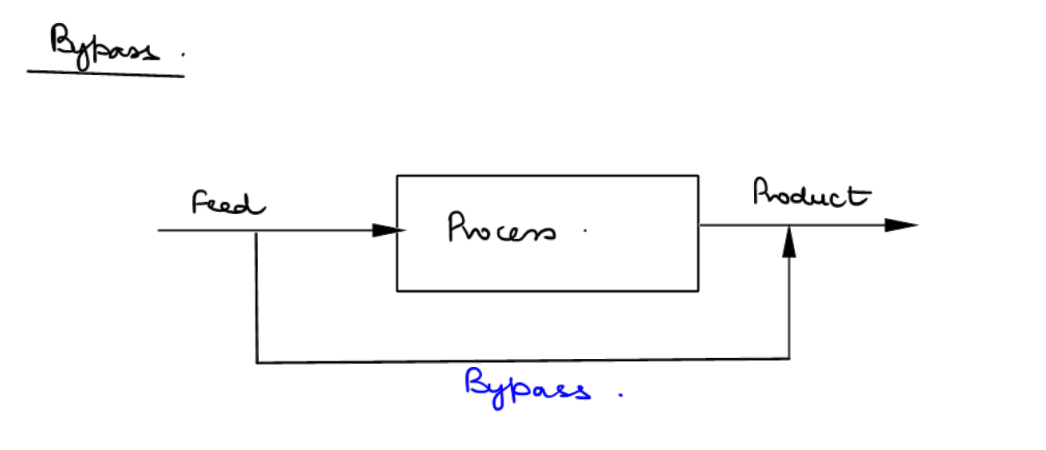
Function:
- When the product is too concentrated.
- When temperature control is needed (exothermic process).
Purge system
Purge removes part of the recycle stream from the system entirely, rather than returning all of it to the feed.
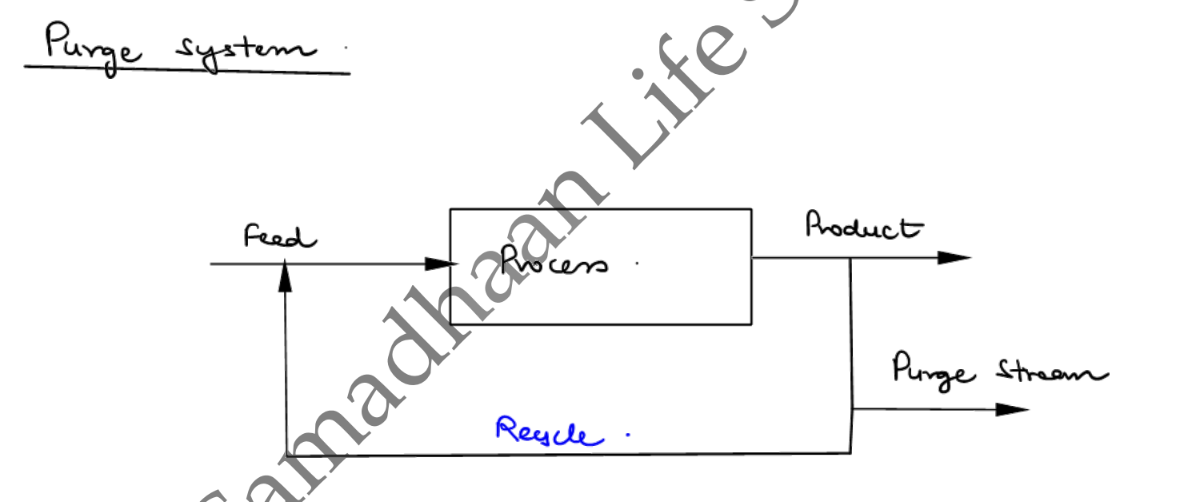
Function:
- If an inert or impurity enters with the feed or forms inside the reactor, recycling it can cause its build-up — a portion of the recycle must be purged to prevent this.
At steady state, whatever inert or impurity enters with the fresh feed has nowhere to go but out with the purge — the recycle stream itself is internal to the loop and doesn't add or remove any of it. That balance is what sets how large the purge needs to be for a given feed impurity level and a given allowed build-up in the loop.
Recycle vs. bypass vs. purge
| Splits from | Rejoins | Purpose | |
|---|---|---|---|
| Recycle | Product stream | Feed, before the process | Increase residence time and overall conversion |
| Bypass | Feed stream | Product, after the process | Control product concentration; temperature control for exothermic processes |
| Purge | Recycle stream | Leaves the system (does not rejoin) | Prevent build-up of inerts or impurities |
Key points
- Recycle returns part of the product stream to the feed to increase residence time and overall conversion — but pushed too far, it can reduce productivity.
- Recycle raises overall conversion of fresh feed, not necessarily single-pass conversion — per-pass performance typically drops toward CSTR-like behavior as the recycle ratio grows.
- Cell recycle decouples hydraulic retention time () from biomass retention time — returning cells that would otherwise wash out lets a bioreactor run at a dilution rate above without washing out.
- Bypass diverts part of the feed around the process and rejoins it with the product, used when the product is too concentrated or when temperature control is needed for an exothermic process.
- Purge bleeds off part of the recycle stream so inerts or impurities entering with the feed, or forming inside the reactor, don't build up.
Common confusion
Recycle, bypass, and purge all add a second stream around the process box, but they connect at different points: recycle splits from the product and rejoins the feed; bypass splits from the feed and rejoins the product, skipping the process; purge splits from the recycle stream and leaves the system rather than rejoining anything.
Overall conversion vs. single-pass conversion — "recycle increases conversion" is true for overall conversion (fresh feed in, unreacted material eventually recovered and reacted), but recycle typically lowers single-pass conversion (just reactor inlet to outlet), because the reactor inlet is diluted with partially-converted recycle material instead of pure fresh feed. These are not the same number, and a claim that recycle "always increases conversion across the reactor vessel" is conflating them.