Chemical Foundations of Life
Atomic number and mass number
- Atomic number (Z) — proton count. Identifies the element; fixes its position on the periodic table.
- Mass number (A) — protons + neutrons. Electrons are ignored (negligible mass).
Isotopes of hydrogen — same Z, different A
| Isotope | Protons | Neutrons | Mass number |
|---|---|---|---|
| Protium (¹H) | 1 | 0 | 1 |
| Deuterium (²H, D) | 1 | 1 | 2 |
| Tritium (³H, T) | 1 | 2 | 3 |
Water — structure and polarity
- Molecular weight — 18 daltons (2 from its two H atoms + 16 from O).
- Bond angle — H–O–H is 104.5°.
- Bent shape + oxygen's higher electronegativity → uneven charge distribution → water is polar.
- CO₂ is not polar — linear and symmetrical, so its two C=O bond dipoles point opposite and cancel exactly.
Why its properties look "too high" for its size
- Unusually high melting point, boiling point, heat of vaporization, and surface tension for an 18-dalton molecule.
- Cause: intermolecular hydrogen bonding between water molecules — breaking enough of these bonds to melt, boil, or vaporize it takes far more energy than the low molecular weight alone would suggest.
Water as a solvent
- Water is the universal solvent — being polar, it dissolves most polar and ionic compounds.
- Hydrophilic — polar; dissolves in water.
- Hydrophobic — nonpolar; virtually insoluble in water.
- Amphipathic compounds have both a polar and a nonpolar region in the same molecule — the hydrophilic region interacts with water, the hydrophobic region avoids it.
- Dielectric constant — a solvent's capacity to neutralize the
attraction between opposite electrical charges.
- Water has a high dielectric constant → weakens the attraction between oppositely charged ions (e.g. Na⁺ and Cl⁻) → makes water a powerful solvent for salts.
Water — acid/base behavior
- Amphoteric — a substance that can act as both an acid and a base.
- Amphiprotic — a substance that can either donate or accept a proton (H⁺). Water is both amphoteric and amphiprotic.
Ionization of water
- — water
- — hydrogen ion (proton)
- — hydroxide ion
Autoionization of water
-
— hydronium ion, water's conjugate acid
-
— hydroxide ion, water's conjugate base
-
Degree of ionization is measured by electrical conductivity.
-
In pure water, mol/L — i.e. 1 L of pure water contains mol of H⁺ ions.
-
On electrolysis, (cation) migrates to the cathode; (anion) migrates to the anode.
Equilibrium constant of water's ionization
-
— equilibrium constant of water's ionization, mol/L
-
— hydrogen ion concentration, mol/L
-
— hydroxide ion concentration, mol/L
-
— molar concentration of water, mol/L
-
Water's degree of autoionization is very small, so is treated as constant: mol/L.
-
at 25°C = mol/L.
Ion product of water ()
-
— ion product of water: product of and in pure water, mol²/L²
-
— hydrogen ion concentration, mol/L
-
— hydroxide ion concentration, mol/L
-
(rolling 's constant concentration into ).
-
at 25°C = mol²/L².
Acidic, basic, and neutral solutions
| Solution | / |
|---|---|
| Acidic | M |
| Neutral | M |
| Basic | M |
pH
- — measure of acidity, unitless
- — hydrogen ion concentration, mol/L
Acids, Bases and pH
- Brønsted-Lowry acid — a substance that donates a proton (H⁺).
- Brønsted-Lowry base — a substance that accepts a proton (H⁺).
Ionization of HCl in water
- — acid 1: donates a proton to become its conjugate base,
- — conjugate base of
- — base 2: accepts a proton to become its conjugate acid,
- — conjugate acid of
Conjugate acid-base pairs: and .
- Strong acids ionize completely in aqueous solution.
- Weak acids do not ionize completely — some HA remains undissociated at equilibrium.
- Equilibrium — rate of the forward reaction equals rate of the reverse reaction; no net change in concentration.
Acid dissociation constant ()
- — undissociated acid
- — hydrogen ion (proton)
- — conjugate base of
- — acid dissociation constant (also acid ionization constant, or acidity constant), mol/L
measures an acid's tendency to lose a proton and form its conjugate base — the equilibrium constant of that ionization.
- — negative log of , unitless
- — acid dissociation constant, mol/L
is the standard way weak acids' proton-donating strength is reported. The stronger the tendency to dissociate a proton, the larger and the lower .
| Acid | Type | (mol/L) | |
|---|---|---|---|
| HCl | Strong | ||
| Acetic acid () | Weak |
A strong acid like ionizes essentially completely, so is huge and is a large negative number. A weak acid like acetic acid only partly ionizes, so is small and is a small positive number.
pH and — the Henderson-Hasselbalch equation
- — measure of acidity of the solution, unitless
- — acid dissociation constant of the acid in question, unitless
- — conjugate base concentration, mol/L
- — undissociated acid concentration, mol/L
Relates a buffered solution's pH to its and the ratio of conjugate base to undissociated acid present.
- When , the ratio is and , so .
- Physical significance — at , the acid is exactly 50% dissociated: equal concentrations of and . This is the buffer's midpoint, where it has the greatest capacity to resist a pH change from added acid or base.
Titration
- Titration — a technique for determining the concentration of a solution of unknown concentration by reacting it with a solution of known concentration, added incrementally until the reaction is complete.
- Titrant — the solution of known concentration, added incrementally (e.g. from a burette).
- Analyte — the solution of unknown concentration being determined.
Titrating a weak acid with a strong base
- The titrant (a strong base, e.g. ) is added to the acid (the analyte) in small increments.
- Addition continues until the acid is fully neutralized.
- The point of neutralization is determined with an indicator dye (color change) or a pH meter.
Titration curve
- Titration curve — a plot of the solution's pH (y-axis) against the amount of (titrant) added (x-axis).
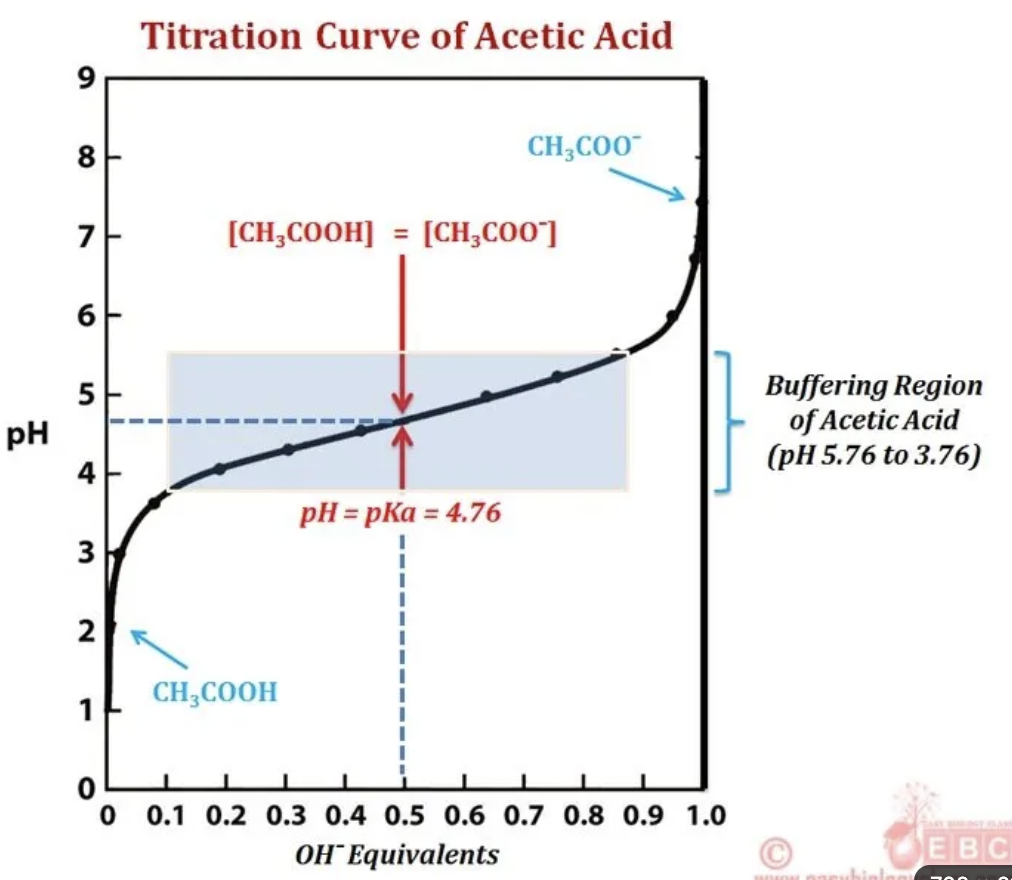
Sequence of the curve, in order as is added
Picture a beaker of acetic acid, and you're dripping in slowly.
- Start (0 equivalents) — the beaker holds almost nothing but intact molecules; only a tiny fraction have broken apart into and . Lots of free around, so pH is low.
- Early rise — you start adding drops of . Each one grabs a free and becomes water. There's barely any around yet to cushion this, so the free- count drops fast and pH climbs quickly.
- Buffering zone begins — enough has now turned into that both are floating around in similar amounts. From here, each drop of reacts with a molecule instead of depleting free directly — and there's so much in reserve that this barely moves the pH. This is the flat stretch on the graph (roughly ; for acetic acid, pH to ).
- Half-equivalence point (0.5 equivalents) — exactly half the original has now been converted, so and are sitting in the beaker in equal amounts. Right here, ( for acetic acid) — the dead centre of the flat stretch, and the point where the buffer can soak up the most added acid or base before pH actually moves.
- Buffering zone ends — most of the is used up now. With little acid left in reserve to react with incoming , pH starts climbing faster again.
- Equivalence point / inflection point (1.0 equivalents) — every molecule has now been converted to — you've added exactly as much as there was acid to begin with. The curve is climbing at its steepest right here. Because is a weak base, it pulls a little back out of water, so the solution actually sits above pH — mildly basic.
- Endpoint — the moment you, running the titration, actually notice this has happened: the indicator dye suddenly changes color, or the pH meter reading jumps. Ideally this lines up with step 6.
- Past equivalence — keep adding now and it's just excess strong base piling up with no more acid left to react with; pH keeps rising, then flattens out high, set by how much extra you've poured in.
Common confusion
- The inflection point (steepest slope) is the equivalence point — not the point where . The point where is the half-equivalence point, sitting in the flat buffering zone, the opposite of where the curve is steepest.
Mirror case: titrating a weak base with a strong acid
Same procedure, reversed: the titrant is a strong acid (e.g. ), the analyte is a weak base (e.g. ). Because acid is being added to a base instead of base to an acid, the curve descends as titrant is added, instead of rising.
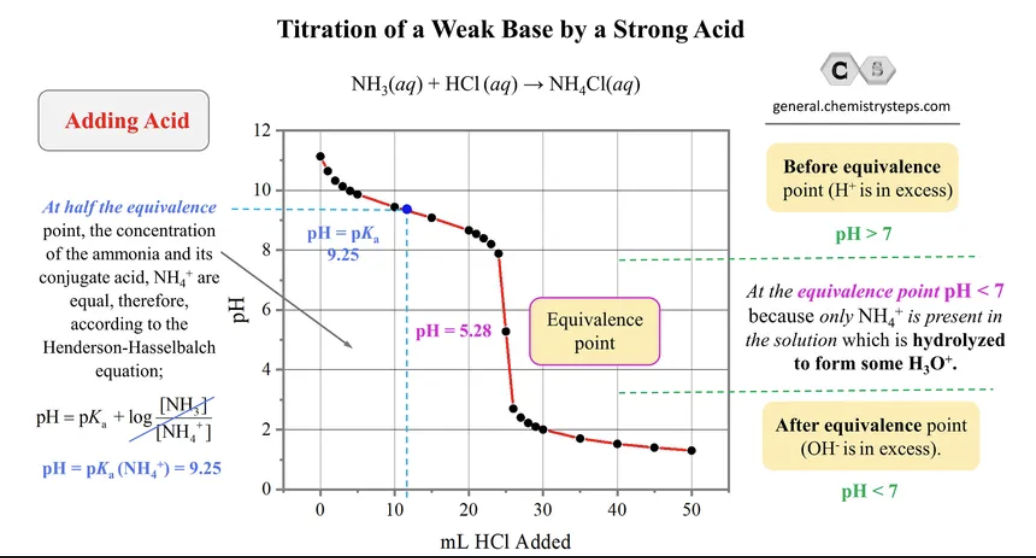
| Weak acid + strong base (acetic acid + ) | Weak base + strong acid ( + ) | |
|---|---|---|
| Titrant | ||
| Curve direction | pH rises as titrant is added | pH falls as titrant is added |
| Species at equivalence point | conjugate base, | conjugate acid, |
| pH at equivalence point | ( hydrolyzes, raising pH) | ( hydrolyzes, lowering pH) |
| pH at half-equivalence point | of | of |
- Equivalence-point pH is not always — it depends on which species (conjugate acid or conjugate base) is left in solution and how it hydrolyzes.
Buffers
- Buffer — an aqueous solution that resists changes to its pH when a small amount of acid or base is added, or when it is diluted.
Acidic and basic buffers
| Composition | pH | |
|---|---|---|
| Acidic buffer | weak acid + its conjugate base | |
| Basic buffer | weak base + its conjugate acid |
Common physiological buffer systems
- Phosphate buffer — weak acid , conjugate base .
- Bicarbonate buffer — weak acid (carbonic acid), conjugate base (bicarbonate ion): . Unlike the phosphate buffer, is itself in equilibrium with dissolved (), so the lungs (via breathing out ) and the kidneys (via excreting ) can both adjust this buffer — it's the main buffer of blood plasma.
What a buffer's pH range and capacity depend on
- Nature of the conjugate pair — its sets which pH the buffer is centered on.
- Concentrations of the pair — the concentrations of and set how much added acid or base the buffer can absorb.
Conditions for an acid buffer to exist
- The solution must contain a weak acid and its salt (the conjugate base).
- The concentrations of the weak acid and its conjugate base must be reasonably similar.
Mechanism — the common ion effect
Buffers operate on the common ion effect. The salt fully dissociates, flooding the solution with the conjugate base ion () — the same ion the weak acid's own ionization () produces. That excess of pushes the weak acid's equilibrium back toward (Le Chatelier's principle), leaving both and sitting in solution at reasonably similar concentrations, ready to react with whatever is added.
Worked example: acetic acid / sodium acetate buffer
Question. How does a mixture of acetic acid () and sodium acetate () resist pH change when a strong acid, a strong base, or water is added?
Solution.
- Sodium acetate is a salt and dissociates completely: — this supplies a large, standing reservoir of the conjugate base, .
- Acetic acid is a weak acid, so it stays mostly undissociated: . The solution now holds both and at reasonably similar concentrations — satisfying the conditions for a buffer.
- Add a strong acid (): the reservoir of absorbs it — . is consumed converting conjugate base into acid, so pH barely changes.
- Add a strong base (): the acid neutralizes it — . The acid is consumed converting into conjugate base and water, so pH barely changes.
- Dilute with water: and both drop by the same factor, so their ratio is unchanged — by the Henderson-Hasselbalch equation, pH stays (nearly) the same.
Answer: Because and are both present in reasonably similar amounts, any added or is consumed converting one species into the other rather than accumulating freely in solution, so pH shifts only slightly.
Key points
- Atomic number = protons; mass number = protons + neutrons.
- Protium, deuterium, tritium = hydrogen's isotopes, with 0, 1, 2 neutrons.
- Water: 18 daltons, bent at 104.5°, polar. CO₂: linear, symmetrical, nonpolar.
- Water's unusually high mp/bp/heat of vaporization/surface tension come from intermolecular hydrogen bonding.
- Hydrophilic = polar = water-soluble. Hydrophobic = nonpolar = water-insoluble. Amphipathic = both, in one molecule.
- High dielectric constant → weaker ionic attraction → water dissolves salts easily.
- Water is amphoteric (acts as acid or base) and amphiprotic (donates or accepts H⁺): , and . → cathode, → anode.
- mol²/L² at 25°C ( mol/L; held constant at mol/L).
- Pure water: mol/L, neutral. Acidic: M. Basic: M.
- .
- Brønsted-Lowry: acid donates H⁺, base accepts H⁺. — conjugate pairs and .
- Strong acids ionize completely; weak acids don't.
- — an acid's tendency to donate its proton; the equilibrium constant of .
- . Larger → lower → stronger acid. Strong acid (): , . Weak acid (acetic acid): , .
- Henderson-Hasselbalch: . When , — the acid is 50% dissociated, the buffer's point of maximum capacity.
- Titration: titrant (known conc.) added to analyte (unknown conc.) until the reaction is complete. A weak acid is titrated with a strong base; the titration curve plots pH vs. added.
- Equivalence point = inflection point (steepest slope): moles titrant added = moles acid originally present. Half-equivalence point (, ) sits in the flat buffering zone instead — the two are easily confused but are opposite points on the curve.
- Curve order (weak acid + strong base, as is added): start (low pH) → early rise → buffering zone begins → half-equivalence () → buffering zone ends → equivalence/inflection point (, endpoint detected here) → past equivalence, pH levels off.
- Mirror case: weak base + strong acid ( + ) — curve falls instead of rises; equivalence-point pH is (conjugate acid hydrolyzes) instead of .
- Buffer = resists pH change on adding acid/base or on dilution. Acidic buffer (weak acid + conjugate base), ; basic buffer (weak base + conjugate acid), . Physiological examples: phosphate buffer (), bicarbonate buffer ( — blood's main buffer, tunable by lungs and kidneys).
- Buffer range/capacity depend on the conjugate pair's and on their concentrations. Requires a weak acid + its salt, at reasonably similar concentrations — works via the common ion effect (excess from the salt suppresses the acid's own ionization).
- Acetic acid/sodium acetate buffer: (from the fully dissociated salt) mops up added ; mops up added ; dilution leaves the ratio — and so the pH — unchanged.