Heat Transfer
Worked examples
Worked example: which changes increase h in a stirred-tank bioreactor
In notes →Question. Which of the following operational modifications will increase the inside convective heat transfer coefficient () in a stirred tank bioreactor? (a) Increasing the impeller agitation speed (b) Increasing the broth temperature (which lowers viscosity) (c) Accumulation of a dense mycelial wall cake (d) Decreasing the broth flow velocity past the heat exchange surface.
Solution.
- (a) Increasing agitation speed — raises turbulence and flow velocity at the wall, thinning the boundary film. Increases .
- (b) Increasing broth temperature (lower viscosity) — less resistance to flow near the wall, effectively raising the Reynolds number. Increases .
- (c) Mycelial wall cake — a solid, low-conductivity layer stuck to the wall acts as fouling: it adds resistance and dampens turbulence at the surface. Decreases .
- (d) Decreasing flow velocity — less turbulence, thicker boundary film. Decreases .
Answer: (a) and (b) increase ; (c) and (d) decrease it.
Worked example: composite bioreactor wall
In notes →Question. A composite bioreactor wall has an inner stainless steel sheet (, ) and outer insulation (, ). Convective resistances are negligible. Find the total conductive resistance per unit area.
Solution.
- Steel: .
- Insulation: .
- (to 3 d.p.) — the insulation dominates since its conductivity is lower than the steel's.
Answer: .
Worked example: LMTD for parallel vs. counter-current flow
In notes →Question. A hot fluid enters a heat exchanger at and leaves at . A cold fluid enters at and leaves at . Find the LMTD for (a) parallel flow and (b) counter-current flow.
Solution.
-
Parallel flow (co-current) — both fluids enter at the same end, so the inlet ends pair together and the outlet ends pair together:
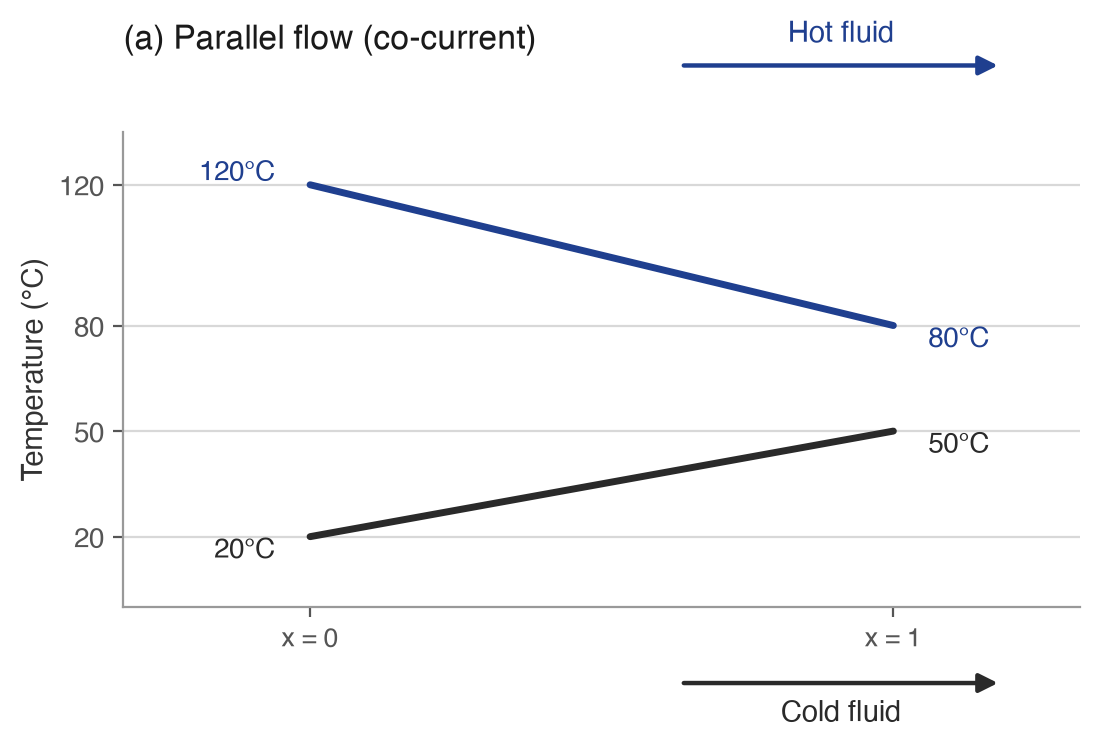
- (both inlets)
- (both outlets)
-
Counter-current flow — the hot inlet pairs with the cold outlet, and the hot outlet pairs with the cold inlet:
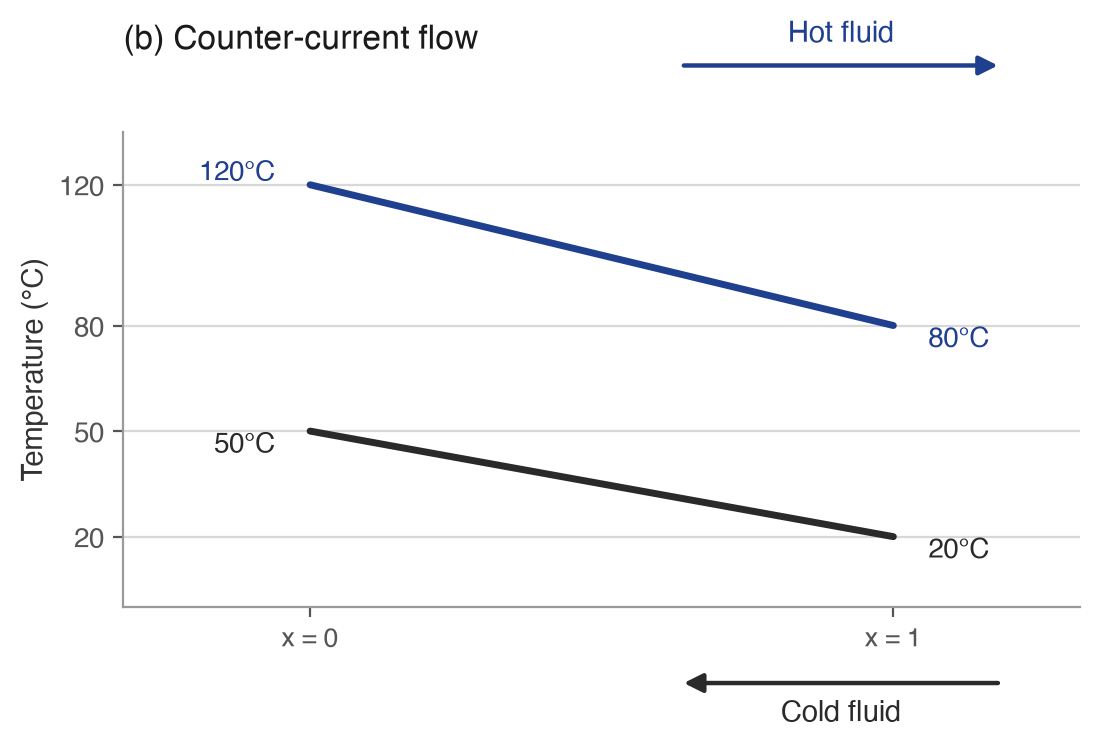
- (hot inlet, cold outlet)
- (hot outlet, cold inlet)
Answer: LMTD for parallel flow, and for counter-current flow — the counter-current arrangement gives the larger LMTD for the same four terminal temperatures.
Worked example: LMTD when the terminal differences are equal
In notes →Question. A counter-current heat exchanger cools hot oil from to using cooling water that heats from to . Find the LMTD.
Solution.
- Counter-current flow: the hot inlet pairs with the cold outlet, and the
hot outlet pairs with the cold inlet.
- (hot inlet, cold outlet)
- (hot outlet, cold inlet)
- , so is . By the equal-terminal-differences limit, .
Answer: LMTD .
Worked example: evaluating heat generation and removal statements
In notes →Question. Select the correct statements regarding heat generation and removal in aerobic bioprocesses: (a) Aerobic microbial growth is accompanied by heat release proportional to the rate of oxygen consumption. (b) The heat of fermentation can be estimated using Cooney's correlation: approximately per mole of consumed (or per g of ). (c) Scale-up of stirred fermenters creates heat transfer challenges because reactor volume scales with , while surface area for cooling scales with . (d) Internal cooling coils are preferred over external jackets for highly shear-sensitive animal cell cultures to minimize volume.
Solution.
- (a) Metabolic heat comes from the same respiratory reactions that consume , so heat release tracks the oxygen uptake rate. Correct.
- (b) This is exactly Cooney's correlation above: . Correct.
- (c) and , so specific cooling area falls as — the standard scale-up cooling bottleneck. Correct.
- (d) Backwards on both counts: external jackets, not internal coils, are preferred for shear-sensitive cultures, precisely because coils add internal turbulence/shear and reduce usable working volume rather than minimizing it. Incorrect.
Answer: (a), (b), and (c) are correct; (d) is incorrect.