Mass Transfer
Mass transfer by diffusion
Mass transfer inside a bioreactor happens through diffusion.
Diffusion
Diffusion is the thermal motion of fluid particles at any temperature above absolute zero — 0 K, or −273 °C.
Fick's law of diffusion
Fick's law of diffusion states that molecules move from areas of higher concentration to areas of lower concentration.
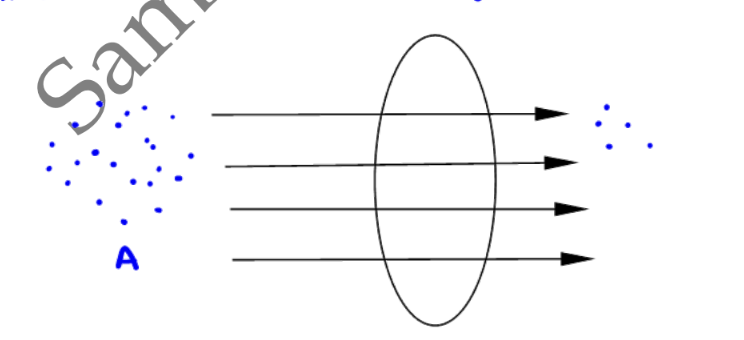
Mass transfer of component A across a cross-sectional area perpendicular to the direction of diffusion can be explained by this law.
- — mass flux of component A (rate of diffusive mass transport per unit cross-sectional area, driven by the concentration gradient), in kilograms per square metre-second ()
- — rate of mass transfer of component A, in kilograms per second ()
- — cross-sectional area, perpendicular to the direction of diffusion, in square metres () — not to be confused with the subscript , which denotes the diffusing component
- — diffusion coefficient of A through B, describing the ease of diffusion, in square metres per second ()
- — mass concentration of component A, in kilograms per cubic metre ()
- — distance in the direction of diffusion, in metres ()
The negative sign in the equation is because diffusion occurs from higher concentration to lower concentration.
Film theory
Film theory states that at the interface between two phases, there exists a thin, stagnant film or layer of fluid. Within this film, mass transfer occurs only via molecular diffusion.
For example, when a bubble enters a bioreactor, a thin film of the same bulk fluid surrounds the bubble. This film makes it difficult for gas inside the bubble to diffuse out of the bubble and into the fluid.
Concentration profile across the film
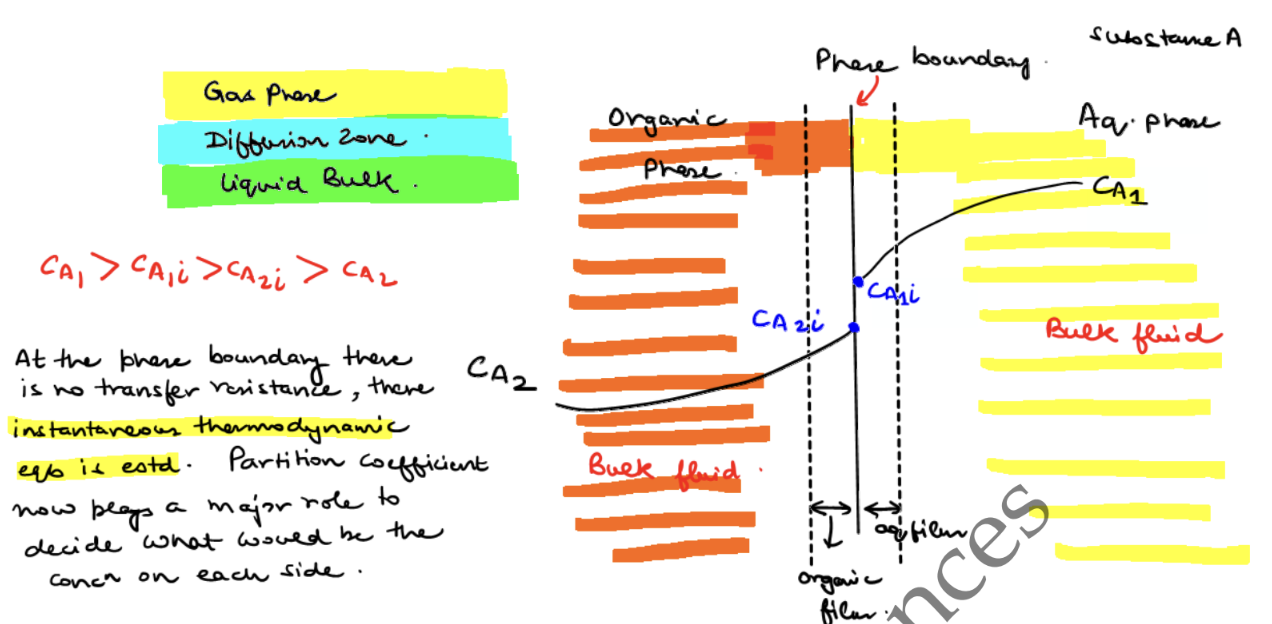
A solute moves from the bulk fluid on one side, across the phase boundary, into the bulk fluid on the other side:
- In the bulk fluid of the first phase (e.g. the aqueous phase), the solute is at concentration .
- Moving through that phase's film toward the phase boundary, the concentration drops to (the interface concentration on this side) — the film poses resistance to transfer, since diffusion is the only way for the solute to move through it.
- At the phase boundary itself, there is no transfer resistance — instantaneous thermodynamic equilibrium is established. The concentration can rise or drop here, from to , because the solubility of the solute differs between the two phases — the partition coefficient decides the concentration on each side.
- Moving across the second phase's film (e.g. the organic phase), the concentration continues to drop, from down to in that phase's bulk fluid.
Overall: .
Within each film, the concentration profile is linear. Film theory assumes steady-state molecular diffusion through the film with no accumulation, and integrating Fick's law under that assumption gives a straight-line concentration gradient — the same reasoning that gives a linear temperature profile across a wall in steady-state heat conduction.
Rate of mass transfer (film theory)
Based on film theory, the mass transfer rate is:
- — volumetric rate of mass transfer (how fast solute crosses the interface into the bulk liquid, driven by the gap between saturation and bulk concentration), in gram-mole per cubic metre per second ()
- — (liquid) film mass-transfer coefficient (how fast a solute molecule crosses the stagnant film — sets the pace of interfacial transfer), in metres per second ()
- — interfacial area per unit volume, in square metres per cubic metre ()
- — saturation concentration: the maximum concentration of the solute that can dissolve in the liquid, in gram-mole per cubic metre ()
- — bulk concentration: the current concentration of the solute in the liquid, in gram-mole per cubic metre ()
is how fast the molecule crosses the film: the thinner the film, the higher , and the faster the transfer.
is the driving force for mass transfer: the bigger the difference between the saturation concentration and the bulk concentration, the more strongly the system pulls the solute into the liquid.
under film theory
Film theory treats the film as a fixed-thickness layer crossed by steady-state molecular diffusion, which gives itself as
- — (liquid) film mass-transfer coefficient (how fast a solute molecule crosses the stagnant film), in metres per second ()
- — diffusion coefficient of the solute through the liquid, in square metres per second ()
- — thickness of the stagnant film, in metres ()
is directly (linearly) proportional to — doubling the diffusivity, with film thickness unchanged, doubles .
Worked example: effect of doubling diffusivity on
Question. If the molecular diffusivity of a solute doubles while keeping all other physical parameters and film thickness constant, according to Whitman's film theory, the mass transfer coefficient will:
- (a) Increase by a factor of ()
- (b) Increase by a factor of
- (c) Increase by a factor of
- (d) Remain unchanged
Solution.
- Film theory gives — a linear relationship between and , with held fixed.
- Doubling (with constant) doubles directly: .
- A factor of (option a) is what penetration or surface renewal theory would predict instead, since those give — not film theory.
Answer: (b) — increases by a factor of .
Interfacial area per unit volume ()
Interfacial area per unit volume () is the total interfacial area between the two phases, divided by the total volume of the liquid (the bulk liquid) in the vessel — not the total vessel volume including the gas phase. In practice, the gas phase (bubbles) occupies only a small fraction of the vessel, so the liquid volume is used as the "total volume" in this ratio.
For a sphere, — so smaller bubbles mean higher . Splitting a fixed total gas volume into equal bubbles multiplies (and the total interfacial area) by . This is why sparging aims to break gas into fine bubbles rather than large ones.
Worked example: interfacial area from bubble size
Question. A sparger releases a fixed volume of gas as a single bubble of diameter . What is the interfacial area per unit volume () for (a) that single bubble, and (b) the same total gas volume split instead into 100 equal smaller bubbles?
Solution.
- For a sphere, .
- Single bubble: , so .
- Splitting a fixed total gas volume into equal bubbles scales by (smaller diameter, more total surface for the same volume).
- For : .
Answer: for the single bubble, rising to once split into 100 smaller bubbles of the same total volume.
Gas hold-up ()
Gas hold-up () is the fraction of the gas-liquid dispersion's volume occupied by gas bubbles at any instant — not the sparging flow rate, but how much gas is actually held up inside the vessel while it rises through the liquid.
- — gas hold-up (fraction of the dispersion's volume occupied by gas bubbles at any instant — how much gas is retained in the liquid, not the sparging flow rate), dimensionless (fraction, –)
- — volume of gas (bubbles) in the dispersion, in cubic metres ()
- — volume of liquid in the dispersion, in cubic metres ()
is what turns single-bubble geometry ( for one sphere) into a vessel-level interfacial area. The general form folds it in directly:
- — interfacial area per unit volume (total gas-liquid contact surface available for mass transfer, per unit liquid volume), in square metres per cubic metre ()
- — gas hold-up (fraction of dispersion volume occupied by gas), dimensionless
- — Sauter mean bubble diameter, in metres ()
The single-bubble worked example above used as shorthand for a fixed total gas volume — that special case works because is the same in both scenarios being compared, so it cancels out. For any absolute calculation, use the full .
What raises (and generally ):
- Higher superficial gas (sparging) velocity — more gas fed per unit time and cross-section means more gas volume held up in the liquid at any instant.
- Smaller bubbles — they rise more slowly, so they spend longer in the liquid before escaping, raising hold-up for the same gas flow rate.
What lowers it:
- Coalescence — bubbles merging into larger ones increases directly and makes bubbles rise faster (less residence time), lowering both and . Coalescence always works against interfacial area, never for it.
- High viscosity — thick, non-Newtonian broths often promote coalescence and slow bubble breakup, generally reducing hold-up and .
Electrolytes — two separate effects, easy to conflate. Dissolved salts (e.g. NaCl, NaSO) do two unrelated things in a sparged system:
- They inhibit bubble coalescence. Ions in solution stabilize the thin liquid film between two approaching bubbles, preventing them from merging. This keeps mean bubble diameter smaller and (and ) higher than in pure water, at the same gas flow rate.
- They lower O solubility () via salting-out (see "Oxygen solubility" below) — a completely separate mechanism (ionic strength suppressing gas solubility, not bubble size).
So electrolytes raise / (via smaller, more stable bubbles) while simultaneously lowering (via salting-out) — two different variables, two different mechanisms, pulling in directions that don't cancel out predictably. There is no "salting-in" effect that raises O solubility here — that term describes a different phenomenon (certain organic solutes becoming more soluble with certain salts), not this case.
Worked example: electrolyte effects in a sparged bioreactor
Question. Which of the following effects occur when pure electrolytes (salts such as NaCl or NaSO) are added to pure water in a sparged bioreactor? (a) Electrolytes inhibit bubble coalescence. (b) Mean bubble diameter decreases at high salt concentrations. (c) Interfacial area increases. (d) Oxygen solubility increases due to the salting-in effect.
Solution.
- Ions stabilize the thin film between approaching bubbles, preventing them from merging — (a) is correct.
- Coalescence inhibition means bubbles stay smaller instead of merging into larger ones as salt concentration rises — (b) is correct.
- Smaller at roughly the same hold-up means rises — (c) is correct.
- Electrolytes lower O solubility via salting-out, not raise it via "salting-in" — (d) gets both the direction and the name of the effect wrong.
Answer: (a), (b), and (c) are correct; (d) is false.
Worked example: which statements about interfacial area are correct
Question. Select the CORRECT statements regarding the gas-liquid interfacial area per unit volume : (a) is related to gas hold-up () and bubble diameter () by . (b) High shear from Rushton turbines reduces mean bubble diameter, thereby increasing . (c) Increasing gas sparging velocity increases gas hold-up, generally increasing . (d) Coalescence of air bubbles increases .
Solution.
- (a) is exactly the general interfacial-area equation above — correct.
- Rushton turbines are high-shear radial impellers; that shear breaks bubbles into smaller ones, and since , a smaller means a higher — (b) is correct.
- Higher sparging (superficial gas) velocity increases (more gas held up in the dispersion at any instant); with roughly unchanged, rises too — (c) is correct.
- Coalescence merges small bubbles into larger ones, increasing . Since , this decreases — (d) is false; it directly contradicts (b) and (c), which both work by keeping bubbles small.
Answer: (a), (b), and (c) are correct; (d) is false.
Volumetric mass transfer coefficient ()
and are hard to measure separately, so they are lumped into a single volumetric mass transfer coefficient, , in reciprocal seconds () — the same film-theory rate equation as above, , just written with and combined into one term instead of kept separate.
and change together (e.g. faster impeller speed raises both), so they're rarely separated in practice. In aerobic fermentation, is oxygen, so represents the bioreactor's oxygen transfer capacity — the standard parameter for bioreactor design and scale-up.
Penetration and surface renewal theories
Penetration theory and surface renewal theory replace film theory's stagnant film with short-lived liquid elements that arrive at the interface, exchange solute by unsteady-state diffusion, then get swept back into the bulk before equilibrium is reached.
Higbie's penetration theory
Every liquid element sits at the interface for the same fixed contact time before being replaced by fresh bulk fluid.
- — liquid film mass-transfer coefficient (how fast a solute molecule crosses into a fresh liquid element during its brief time at the interface), in metres per second ()
- — diffusion coefficient of the solute through the liquid, in square metres per second ()
- — contact time of a liquid element at the interface before it is replaced, in seconds () — assumed identical for every element
This gives — a square-root dependence, unlike film theory's linear .
Danckwerts' surface renewal theory
Danckwerts kept the same short-lived-element picture but dropped the assumption of equal contact time: elements are replaced at random, with a fractional rate of surface renewal describing the probability per unit time that any given element gets swapped out.
- — liquid film mass-transfer coefficient (how fast a solute molecule crosses into a fresh liquid element before it is swept away), in metres per second ()
- — diffusion coefficient of the solute through the liquid, in square metres per second ()
- — fractional rate of surface renewal (probability per unit time that a given liquid element gets swapped out for fresh bulk fluid), in reciprocal seconds ()
Like Higbie's theory, — the two theories share the same diffusivity dependence even though they disagree on how contact time is distributed.
Comparing the three theories
| Theory | Interface picture | Contact time assumption | vs. |
|---|---|---|---|
| Whitman film theory | stagnant film, steady-state diffusion | not applicable (steady state) | |
| Higbie penetration theory | short-lived elements, unsteady diffusion | same fixed for every element | |
| Danckwerts surface renewal theory | short-lived elements, unsteady diffusion | random distribution of ages, rate |
The exponent identifies the theory family — 1.0 for film theory, 0.5 for either penetration or surface renewal. Distinguishing Higbie from Danckwerts then comes down to the contact-time assumption, not the exponent: fixed and equal (Higbie) vs. randomly distributed (Danckwerts).
Worked example: which theory does each statement describe?
Question. Which of the following statements comparing mass transfer theories are correct?
- (a) Whitman's film theory predicts is directly proportional to raised to the power .
- (b) Higbie's penetration theory predicts is proportional to raised to the power .
- (c) Danckwerts' surface renewal theory assumes all liquid elements stay at the interface for the exact same contact time.
- (d) Both Higbie's and Danckwerts' theories predict is proportional to .
Solution.
- Film theory models the film as a fixed-thickness, steady-state diffusion path: , which is linear in . (a) is correct.
- Higbie's is a square-root dependence. (b) is correct.
- "Exact same contact time for every element" is Higbie's assumption, not Danckwerts' — Danckwerts specifically replaced it with a random distribution of surface ages. (c) is incorrect, since it describes the wrong theory.
- Danckwerts' is also a square-root dependence, matching Higbie's. (d) is correct.
Answer: (a), (b), and (d) are correct; (c) is incorrect.
Oxygen uptake in a bioreactor
Rate of oxygen transfer
- — volumetric rate of oxygen transfer (OTR — how fast oxygen crosses from gas bubbles into the broth; must keep pace with cellular consumption for aerobic growth), in gram-mole per cubic metre per second ()
- — volumetric mass transfer coefficient (lumps film coefficient and interfacial area into one measurable term — the standard parameter for bioreactor aeration design and scale-up), in reciprocal seconds ()
- — saturation concentration of oxygen in the liquid (its maximum solubility), in gram-mole per cubic metre ()
- — instantaneous concentration of oxygen in the liquid, in gram-mole per cubic metre ()
Henry's law and
Oxygen is a sparingly soluble gas in aqueous media — at , water in equilibrium with ambient air holds only about – dissolved O (– ). This small number is exactly why has to be so large in aerobic fermentation: the absolute driving force available at any moment is tiny.
isn't a fixed property of oxygen — it's set by Henry's law, which relates the partial pressure of a gas above a liquid to its equilibrium (saturation) concentration dissolved in that liquid:
- — partial pressure of oxygen in the gas phase, in pascals ()
- — Henry's law constant for oxygen in the liquid (measures how reluctant the gas is to dissolve — higher means lower solubility at the same partial pressure), in pascal-cubic-metre per gram-mole () — depends on the gas, the liquid, and temperature
- — saturation concentration of oxygen in the liquid, in gram-mole per cubic metre ()
For a fixed oxygen partial pressure in the sparged gas, — so moves opposite to .
Factors affecting
Per , anything that changes or changes :
-
Partial pressure of oxygen in the inlet gas, . Richer oxygen content in the sparged gas (e.g. oxygen-enriched air) directly raises , and so .
-
Total headspace/system pressure. By Dalton's law, — for the same gas composition, raising the total pressure (as in a pressurized fermenter) raises in proportion, and so . This is why pressurizing a fermenter is a real technique for boosting oxygen supply.
-
Temperature. increases with temperature — dissolving a gas into a liquid is exothermic, so by Le Chatelier's principle, raising temperature shifts the gas–liquid equilibrium back toward the gas phase, and less gas stays dissolved:
So a hotter broth has a lower, not higher, oxygen saturation concentration — the opposite of what intuition about "warm liquids dissolve more gas" might suggest. This is the same fact as the temperature factor for above, now traced back to its cause: it's rising with temperature that shrinks and squeezes the driving force.
-
Dissolved solutes (salts, sugars). Dissolved electrolytes and sugars in the medium raise the effective for oxygen — the salting-out effect — so a real fermentation broth has a lower than pure water at the same temperature and .
Worked example: which factors affect ?
Question. Which of the following physical factors influence the saturation dissolved oxygen concentration () in a bioreactor?
- (a) Partial pressure of oxygen in the inlet gas stream
- (b) Total bioreactor headspace pressure
- (c) Temperature of the broth
- (d) Concentration of dissolved salts and sugars in the medium
Solution. All four are genuine factors, via :
- (a) sets directly. Correct.
- (b) sets indirectly, through Dalton's law (). Correct.
- (c) sets — higher temperature raises and lowers . Correct.
- (d) also sets , via the salting-out effect — dissolved solutes raise and lower relative to pure water. Correct.
Answer: all four, (a)–(d), influence .
Worked example: true/false on oxygen transfer fundamentals
Question. Which of the following statements regarding oxygen transfer in aerobic bioreactors is/are TRUE?
- (a) The driving force for oxygen transfer across the liquid film is .
- (b) The addition of surfactants/antifoam agents generally decreases by adding interfacial resistance.
- (c) Smaller bubble size increases the gas-liquid interfacial area per unit volume .
- (d) Dissolved oxygen saturation solubility increases with increasing temperature.
Solution.
- The film-theory rate equation is — the concentration gap between saturation and bulk is exactly the driving force. (a) is true.
- Antifoam agents are surfactants: they add a resistive film at the interface, lowering . (b) is true.
- Smaller bubbles mean more total surface area for the same gas volume ( for a sphere) — smaller gives larger . (c) is true.
- By Henry's law, , and increases with temperature (gas dissolution is exothermic) — so decreases with temperature, not increases. (d) is false.
Answer: (a), (b), and (c) are true; (d) is false.
Worked example: oxygen solubility claims
Question. Select the CORRECT statements regarding oxygen solubility in aqueous fermentation broth: (a) O is a sparingly soluble gas, with typically around – at under ambient air. (b) Increasing bioreactor temperature increases . (c) Increasing vessel headspace pressure increases according to Henry's law. (d) High concentrations of dissolved electrolytes and sugars decrease via the salting-out effect.
Solution.
- (a) is the standard textbook solubility value for O in water at room temperature under air — correct.
- increases with temperature (gas dissolution is exothermic), so falls as temperature rises, not rises — (b) is false.
- Henry's law makes directly proportional to ; raising headspace pressure raises (Dalton's law) and therefore — (c) is correct.
- Dissolved electrolytes and sugars raise the broth's effective (salting-out), which lowers — (d) is correct.
Answer: (a), (c), and (d) are correct; (b) is false.
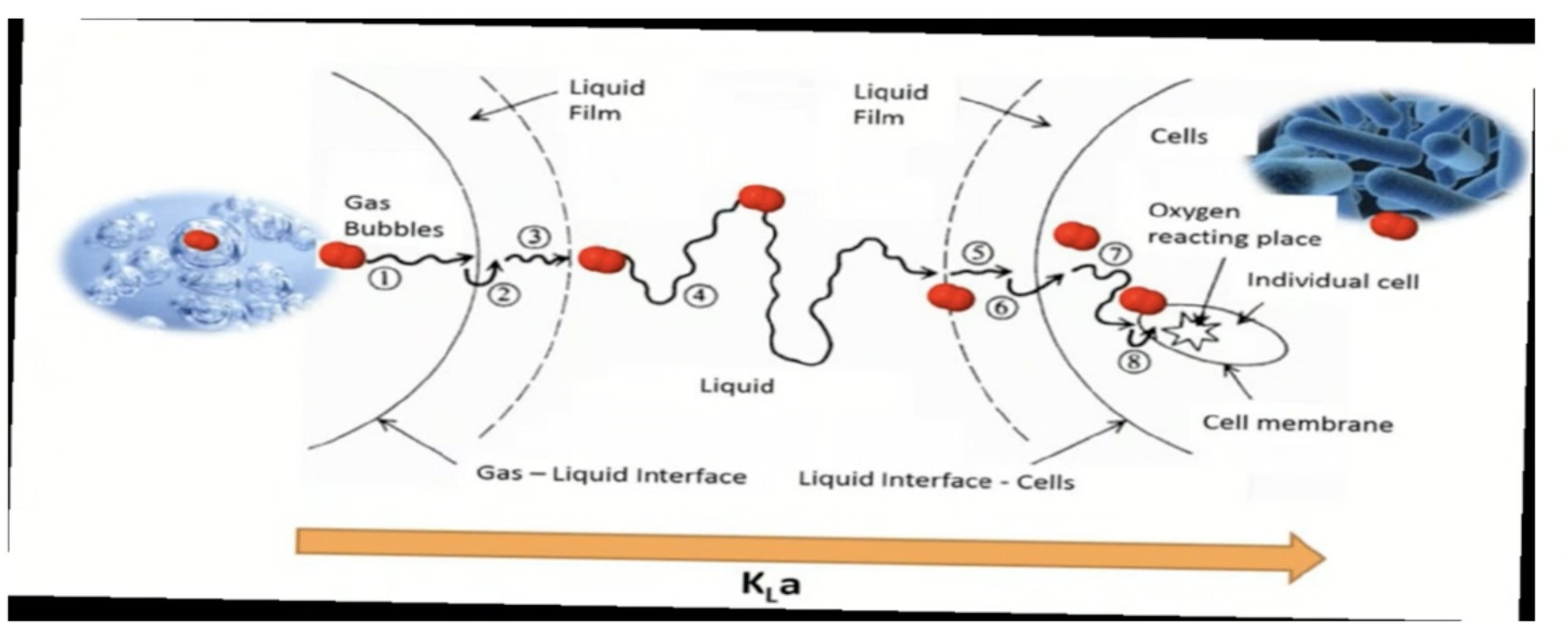
Oxygen travels from a gas bubble to a cell's reaction site through eight resistances in series:
- Transfer from the interior of the bubble to the gas-liquid interface
- Transfer across the gas-liquid interface
- Diffusion through the liquid film around the bubble
- Transport through the bulk liquid
- Diffusion through the liquid film around the cell
- Movement across the liquid-cell interface
- For cells in a clump, diffusion to the individual cell
- Transport through the cytoplasm to the reaction site
Step 3 — diffusion through the liquid film around the bubble — is the largest resistance, which is why (built around that film) is the parameter that governs overall oxygen transfer.
This holds for free unicellular cells in well-mixed suspension, and rests on two other facts about the eight steps:
- Step 2 (gas-film resistance) is negligible. O diffuses roughly four orders of magnitude faster in the gas phase than in the liquid phase, so for a sparingly-soluble gas like O almost all the resistance sits on the liquid side of the interface — this is why only the liquid-film coefficient () appears in , with no matching gas-film term.
- Step 5 (liquid film around the cell) is negligible for small, free cells. A single bacterium or yeast cell is small enough, and its own mass-transfer coefficient high enough, that this film contributes almost nothing next to step 3 — don't confuse it with the bubble's film.
Exception: mycelial pellets. For filamentous fungi growing as pellets or clumps (step 7 in the list), O must additionally diffuse through the biomass matrix to reach cells at the core. Past a critical pellet radius, this intra-pellet diffusion resistance dominates instead — large enough pellets can starve their core of oxygen entirely (an anoxic core), even when at the bubble is perfectly adequate. So "the liquid film around the bubble is always the dominant resistance" is only true for free-cell suspensions, not pelleted or flocculated growth.
Worked example: which resistance dominates, and when
Question. Which of the following statements about O transfer resistances from a gas bubble to a microbial cell in a stirred bioreactor are correct? (a) For unicellular bacteria in well-mixed suspension, the primary resistance is the liquid film around the gas bubble. (b) Gas-film resistance is practically negligible. (c) For fungal mycelial pellets, intra-pellet O diffusion is a significant resistance. (d) The liquid film around an individual bacterial cell is the dominant resistance for all aerobic bioprocesses.
Solution.
- For free unicellular cells, step 3 (liquid film around the bubble) is the largest of the eight resistances — (a) is correct.
- O's gas-phase diffusivity is far higher than its liquid-phase diffusivity, so the gas film (step 2) contributes negligible resistance — (b) is correct.
- Mycelial pellets add an extra resistance step not present for free cells: diffusion through the pellet's own biomass to reach interior cells, which becomes dominant past a critical pellet size — (c) is correct.
- (d) conflates two different films: the film around the cell (step 5, negligible for small free cells) with the film around the bubble (step 3, the actual dominant resistance) — and ignores that pellets shift the dominant resistance elsewhere entirely. "For all aerobic bioprocesses" is false.
Answer: (a), (b), and (c) are correct; (d) is false.
Factors affecting cellular oxygen demand
- Species of bacteria consuming the oxygen
- Growth phase the cells are in
- Nature of the carbon source fed to the cells
Rate of oxygen consumption per cell
- — specific oxygen uptake rate: oxygen required by one cell, in gram-mole per gram (dry cell weight) per second ()
- — biomass (cell) concentration, in grams (dry cell weight) per cubic metre ()
- — oxygen uptake rate of the whole bioreactor (OUR), in gram-mole per cubic metre per second ()
OTR equals OUR at steady state
At steady state, oxygen is consumed as fast as it is supplied, so the oxygen transfer rate equals the oxygen uptake rate: , which gives
Dependence on dissolved oxygen concentration
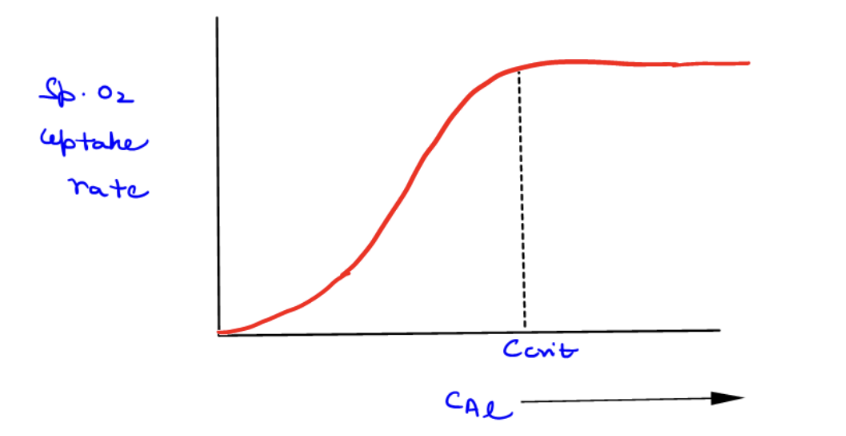
- If : there isn't enough dissolved oxygen around the cell, so it can't take up oxygen any faster than that supply allows.
- If : the cell is already taking up oxygen as fast as it can, so more dissolved oxygen doesn't speed it up further.
Two special conditions
Maximum — set in :
This is the minimum aeration/agitation capability a bioreactor must be designed for to keep the culture above at a given cell load.
Maximum cell concentration — set (no oxygen left in the bioreactor) in :
This gives the theoretical ceiling on biomass density a given aeration setup can sustain — the limit you'd hit before scaling up oxygen supply.
Factors affecting
1. Bubble size
There's a reference bubble size around –:
- Bubble size –: interfacial area drops, so decreases.
- Bubble size –: surface tension turns tiny bubbles into rigid spheres, which stops internal circulation and slightly lowers — but the resulting jump in interfacial area easily outweighs that drop, so increases overall.
Sparger design sets the bubble size at the source. A large single orifice sparger releases coarse bubbles; a sintered (micro)sparger forces gas through many fine pores instead, producing much smaller bubbles — pushing , and so , up.
2. Viscosity
- Viscosity↑ → resistance to OTR increases → decreases.
- Viscosity↓ → resistance to OTR decreases → increases.
3. Stirrer speed
increases directly with stirrer speed.
4. Temperature
Temperature pulls in two directions at once:
-
Helps the kinetics: temperature↑ → viscosity↓ and diffusivity ↑ → ↑, so ↑.
-
Hurts the driving force: temperature↑ → gas solubility ↓ (dissolution is exothermic), shrinking in
So higher temperature speeds up transfer kinetics but weakens the driving force behind it.
5. Gas sparging rate and coalescence
- Sparging (superficial gas) velocity↑ → gas hold-up ↑ → (and )↑, since — see "Gas hold-up" above. Equivalently: more gas fed in means more gas held up and more total interfacial area.
- Coalescence → bubbles merge, ↑ → ↓ → ↓. Coalescence always reduces interfacial area — it works against everything sparging and impeller shear are trying to achieve.
- Sparger design matters too: a sintered microsparger produces much finer bubbles than a large single orifice at the same flow rate, raising (and ) for the same gas input.
6. Antifoam agents
Chemical antifoams (commonly silicone-based surfactants) control foam but come at a direct cost to , especially at high concentration:
- They lower surface tension in a way that promotes bubble coalescence into fewer, larger bubbles (bigger , lower ).
- They form a hydrophobic film at the gas-liquid interface that adds its own resistance to O diffusion, lowering directly.
Excess antifoam is a common, easily overlooked way to cripple oxygen transfer even while foam is well controlled — dose the minimum needed, not the maximum tolerated.
Worked example: which changes raise ?
Question. Which of the following operational modifications will result in an increase in in an agitated bioreactor? (a) Increasing the impeller rotational speed () (b) Increasing the sparging gas flow rate (c) Adding a chemical antifoam agent at high concentration (d) Replacing a large single orifice sparger with a sintered microsparger.
Solution.
- Higher impeller speed increases turbulence and breaks bubbles smaller — increases. (a) is correct.
- Higher gas flow rate means more gas hold-up and more total interfacial area — increases. (b) is correct.
- High-concentration antifoam promotes coalescence and adds interfacial resistance, both of which lower rather than raise it. (c) is incorrect.
- A sintered microsparger produces much finer bubbles than a large single orifice, raising — increases. (d) is correct.
Answer: (a), (b), and (d) increase ; (c) decreases it.
Worked example: which factors decrease
Question. Which of the following factors will cause a DECREASE in in an agitated fermenter? (a) Addition of excess chemical antifoam agents (b) Increase in broth apparent viscosity due to mycelial fungal growth (c) Increasing the agitation speed from rpm to rpm (d) Coalescence of smaller gas bubbles into larger bubbles.
Solution.
- Excess antifoam promotes coalescence and adds its own interfacial resistance — both lower — (a) decreases it.
- Higher viscosity increases resistance to oxygen transfer, lowering — (b) decreases it.
- increases directly with stirrer speed — raising rpm from to increases , it doesn't decrease it — (c) is not a decreasing factor.
- Coalescence increases , which lowers and therefore — (d) decreases it.
Answer: (a), (b), and (d) decrease ; (c) increases it instead.
Methods of measuring
1. Oxygen (gas) balance method
Measure the oxygen flow rate into and out of the fermenter, and back out from the difference:
- — volume of liquid in the fermenter, in cubic metres ()
- — volumetric gas flow rate, in cubic metres per second ()
- — concentration of oxygen in the gas phase, in gram-mole per cubic metre ()
- subscripts , — inlet and outlet gas streams
This measured is then equated to to solve for .
Why it's useful: this method is non-invasive — it samples the gas streams, not the broth — and can run continuously throughout an active fermentation without interrupting aeration or agitation, unlike the dynamic gassing-out method below. It needs accurate measurement of both inlet and outlet gas flow rates and compositions ( and on each side); it does not need any knowledge of liquid film thickness — that's a film-theory construct behind , not something this macroscopic gas-phase balance ever measures directly.
Simplifying the gas flow rates: in general can differ between inlet and outlet, because O is consumed and CO is produced at different molar rates. If the respiratory quotient ( moles CO produced moles O consumed) is close to , the loss of O moles is offset almost exactly by the gain of CO moles, so the total inlet and outlet volumetric gas flow rates end up nearly equal () — simplifying the balance considerably.
Worked example: what the off-gas balance method does and doesn't need
Question. Select the CORRECT statements regarding the off-gas oxygen balancing method for measuring OTR: (a) It is a non-invasive, continuous method that can be applied during active fermentation. (b) It requires accurate measurement of inlet and exit gas flow rates and gas compositions. (c) It depends heavily on knowing the exact value of the liquid film thickness. (d) If respiratory quotient (RQ) is close to , inlet and outlet total volumetric gas flow rates are nearly equal.
Solution.
- The method only samples gas streams, never the broth, and runs continuously without interrupting the process — (a) is correct.
- The defining equation needs exactly and on both the inlet and outlet sides — (b) is correct.
- Film thickness is a film-theory construct behind , not something this macroscopic gas-phase mass balance ever measures — (c) is false.
- means moles of O consumed moles of CO produced, so the total gas-phase mole (and volumetric flow) count barely changes between inlet and outlet — (d) is correct.
Answer: (a), (b), and (d) are correct; (c) is false.
2. Dynamic gassing-out method (most important)
The oxygen supply is interrupted at , dissolved oxygen falls, supply is restored, and climbs back up toward a steady level . Two points on that recovery curve, and , give:
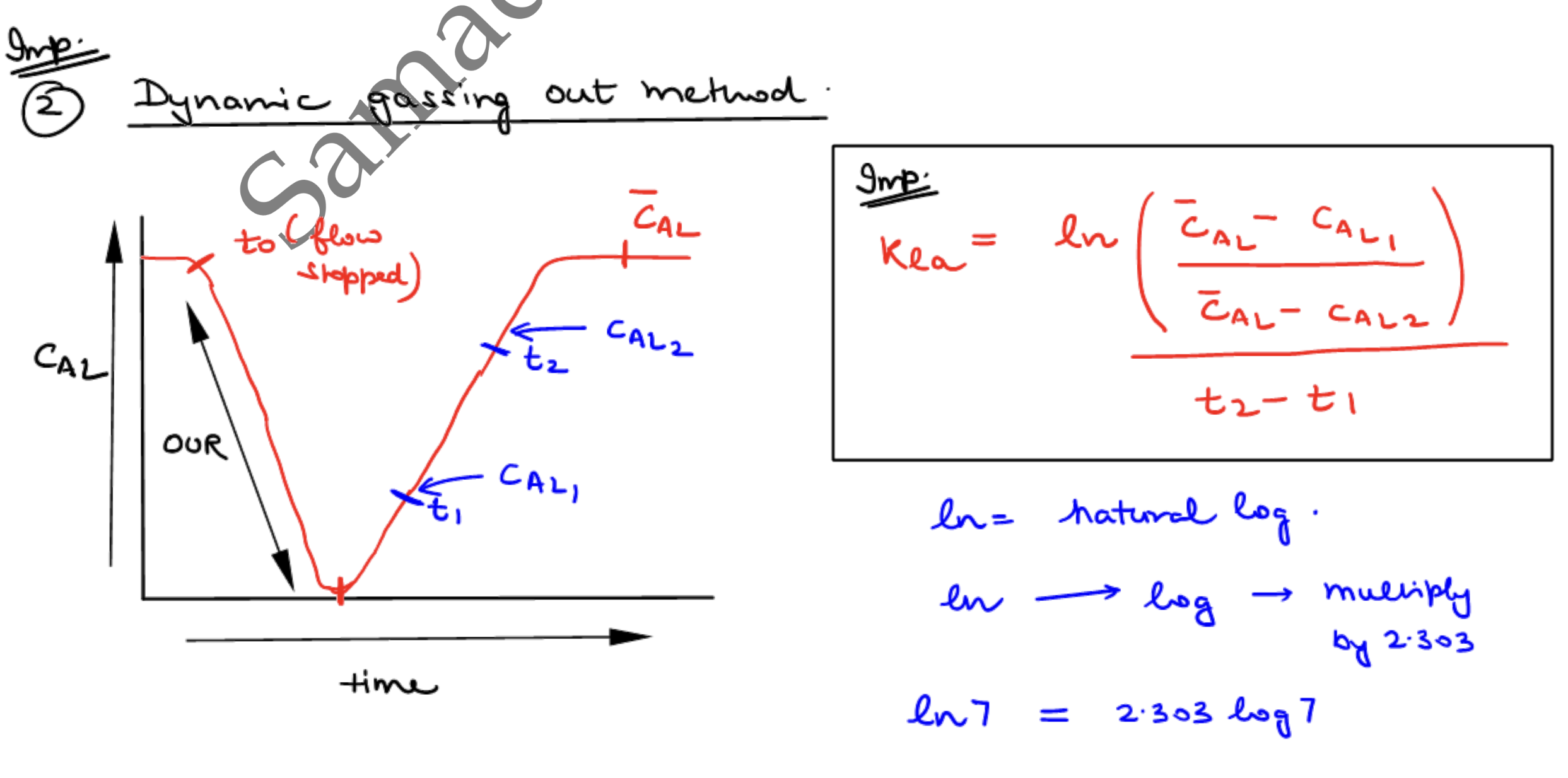
- — volumetric mass transfer coefficient (the aeration parameter being measured, read off the slope of the reoxygenation recovery curve), in reciprocal seconds ()
- — time at which the oxygen supply is cut off
- , — two time points during reoxygenation, at which the instantaneous oxygen concentrations are and
- — oxygen level reached at steady state after reoxygenation
( is the natural log; if only base-10 log tables are available, .)
This shared formula covers two distinct named variants, which differ in how de-oxygenation happens and — critically — in what actually equals.
Variant A: dynamic method with respiring cells (Taguchi–Humphrey)
De-oxygenation happens through the culture's own respiration: cutting off the air supply is what starves the broth of oxygen, since the cells themselves consume the residual dissolved oxygen (this decline phase can even be used separately to read off the OUR). Air is then switched back on and climbs back toward .
vs. — don't conflate them. Because the respiring culture keeps consuming oxygen even during recovery, the level actually settles at () sits below the true no-consumption saturation value (): . Using in the ratio instead of gives the wrong . This variant specifically requires a living, respiring culture — unlike the variant below, and unlike the sulphite oxidation method, which needs oxygen consumption to be purely chemical, not biological.
Variant B: physical gassing-out method (nitrogen stripping)
The alternative way to de-oxygenate: actively strip dissolved O by sparging nitrogen gas through the broth, with nothing biological consuming it. Air is then switched back on, and because nothing consumes oxygen during recovery, the system approaches the true saturation value directly — here , so the formula can safely be written with . This variant is useful when respiration alone is too slow, or when characterizing a broth's (e.g. its rheology effects) independent of any organism — it can be run on cell-free medium or before inoculation.
Dissolved salts don't interfere with either variant — the method works in real fermentation media exactly as it does in plain water.
Probe lag is a real limitation, in either variant. The method assumes the dissolved-oxygen probe responds instantly to changes in , but every DO probe has its own response time (set by its membrane and internal electrode geometry). If is comparable to or larger than , the probe can't keep up with the true recovery curve and its reading lags behind reality — the raw data must then be corrected for probe dynamics (e.g. fitting a first-order probe-response model) before can be extracted correctly. A fast probe () avoids the correction entirely.
What physically means. has units of , so its reciprocal is a time constant — the characteristic time scale of reoxygenation, exactly like in any first-order approach to equilibrium. After one time constant () the system has closed of the gap to ; after three, ; after five, essentially done. A well-aerated reactor with reoxygenates on a timescale; a poorly aerated one with takes . Comparing to is just comparing the probe's own reaction speed to the reaction speed of the thing it's trying to measure — a probe with is badly lagged against the fast case above but effectively instantaneous against the slow one.
Worked example: which assertions about the respiring-cells variant are correct?
Question. Select the CORRECT assertions regarding the dynamic gassing-out method (Variant A, with a respiring culture) for determining :
- (a) The broth is first de-oxygenated by sparging nitrogen gas.
- (b) Dissolved oxygen is monitored as a function of time after air sparging is resumed.
- (c) The slope of versus time yields .
- (d) The method cannot be applied if living, respiring microorganisms are present.
Solution.
- In this variant, de-oxygenation comes specifically from the culture's own respiration once air is cut off — nitrogen sparging belongs to Variant B, not this one. (a) is incorrect here.
- This is exactly the recovery phase the method measures: air resumes and is tracked climbing back up. (b) is correct.
- The correct ratio uses (the level actually reached under respiration), not (the no-consumption saturation value) — see the distinction above. (c) is incorrect as stated.
- The opposite is true: this variant is specifically designed to be used with a living, respiring culture. (d) is incorrect.
Answer: (b) only.
Worked example: correctness checks across both variants
Question. Regarding the dynamic gassing-out method for determining in a fermenter, which of the following statements is/are CORRECT? (a) De-oxygenation of the broth is achieved by sparging nitrogen gas or shutting off aeration while respiring cells consume oxygen. (b) The slope of the line obtained by plotting against during re-aeration directly yields . (c) If the DO probe response time () is comparable to or larger than , probe lag must be corrected. (d) The method cannot be used if the liquid broth contains dissolved salts.
Solution.
- Both routes are real — they're just the two different named variants above (respiring-cells vs. nitrogen-stripping), not two options within a single technique. (a) is correct as a statement about the method family as a whole.
- This is the two-point slope form of the recovery curve. Note that here is only literally exact for Variant B (nitrogen-stripped); for Variant A the correct baseline is , not the true (see above). Read at the level this question intends, the underlying "slope of vs. time" technique is what yields either way. (b) is correct, with that caveat in mind.
- A slow DO probe can't track the true recovery curve once its own response time approaches the process time scale , so its lag must be corrected for — (c) is correct.
- Dissolved salts are present in essentially every real fermentation broth and don't interfere with this method — (d) is false.
Answer: (a), (b), and (c) are correct; (d) is false — but remember which baseline ( vs. ) is actually correct depends on which variant you're running.
3. Sulphite oxidation method
Sodium sulphite reacts with dissolved oxygen as fast as it enters the liquid, catalysed by trace amounts of Cu or Co (added as a copper or cobalt sulphate salt):
This only works because, at moderate-to-high sulphite concentrations (above roughly ), the reaction is zero-order with respect to sulphite — the rate is independent of how much sulphite is left, so it stays fast enough to consume oxygen the instant it dissolves. That's what makes the method valid: the measured rate reflects pure mass transfer, not reaction kinetics. (At low sulphite concentration this breaks down — the reaction becomes rate-limiting instead, and the method no longer measures correctly.)
Reaction order describes how sensitive a reaction's rate is to a reactant's concentration, from the empirical rate law . It's the reason zero-order is a requirement here, not just an incidental fact:
| Order () | Rate law | If sulphite were consumed during the assay | Effect on the method |
|---|---|---|---|
| Zero (, actual) | rate | Rate stays constant — sulphite level doesn't matter | Works: measured rate = pure O mass transfer |
| Half () | rate | Rate drifts mildly as sulphite depletes | Partially confounded — some kinetic drift mixed into the reading |
| First () | rate | Rate falls proportionally with sulphite | Confounded — can't tell a rate change from less O arriving vs. less sulphite left |
| Second () | rate | Rate falls off sharply (quadratically) | Worst case — small sulphite depletion swings the rate hard; kinetics dominate over mass transfer |
As rises, the measured oxidation rate stops being a clean proxy for and starts reflecting how much sulphite is left instead. The method is only valid in the concentration range where the reaction has settled into zero order — the one regime where the chemistry gets out of the way and lets the measurement see the physics (mass transfer) directly.
Because the sulphite binds oxygen immediately, no free oxygen accumulates in solution — — so the driving force collapses to just :
Worked example: catalyst and reaction order in the sulphite method
Question. During measurement by the sulphite oxidation method, sodium sulphite is converted to sodium sulphate in the presence of a catalyst. The catalyst commonly used and the reaction order with respect to sulphite at moderate concentrations are: (a) Cu, first-order (b) Co, zero-order (c) Fe, second-order (d) Zn, half-order.
Solution.
- Co (cobaltous sulphate) is a standard catalyst for this reaction, alongside Cu — rules out (c) and (d), which use catalysts not associated with this method.
- The method's validity depends on the reaction being fast enough to never be rate-limiting: at moderate-to-high sulphite concentrations, the rate is independent of sulphite concentration — zero-order.
- (a) pairs a valid catalyst with the wrong order (first-order would make the reaction rate-limiting, defeating the method's purpose) — so only (b) pairs a valid catalyst with the correct kinetics.
Answer: (b) Co, zero-order.
Key points
- Fick's law () always runs high concentration to low; film theory assumes a linear concentration profile across each stagnant film — steady-state diffusion, no accumulation, same reasoning as linear conduction through a wall.
- Film theory gives ; penetration (Higbie) and surface renewal (Danckwerts) theories both give — the two square-root theories differ only in their contact-time assumption: fixed and equal (Higbie) vs. randomly distributed (Danckwerts).
- At the phase boundary itself there is no resistance — instantaneous equilibrium — and it's the partition coefficient, not diffusion, that decides the concentration jump between the two phases there.
- and move together and can't be measured separately, so they're lumped into , the volumetric mass transfer coefficient — in aerobic fermentation this is the reactor's oxygen transfer capacity, the standard scale-up parameter.
- Of the eight resistances between a gas bubble and a cell's reaction site, diffusion through the liquid film around the bubble is the largest — which is why (built around that film) governs overall O transfer.
- At steady state, OTR = OUR: . Setting gives the minimum a reactor needs to design for; setting gives the maximum biomass a given aeration setup can sustain.
- Temperature is a trade-off for : it speeds up the kinetics (viscosity↓, diffusivity↑ → ↑) but shrinks the driving force (solubility ↓, since dissolution is exothermic).
- The dynamic gassing-out method is the standard way to measure : cut the air supply, let dissolved O fall, restart it, and read off the slope of the recovery curve between two timepoints.