Mass Transfer
Worked examples
Worked example: effect of doubling diffusivity on
In notes →Question. If the molecular diffusivity of a solute doubles while keeping all other physical parameters and film thickness constant, according to Whitman's film theory, the mass transfer coefficient will:
- (a) Increase by a factor of ()
- (b) Increase by a factor of
- (c) Increase by a factor of
- (d) Remain unchanged
Solution.
- Film theory gives — a linear relationship between and , with held fixed.
- Doubling (with constant) doubles directly: .
- A factor of (option a) is what penetration or surface renewal theory would predict instead, since those give — not film theory.
Answer: (b) — increases by a factor of .
Worked example: interfacial area from bubble size
In notes →Question. A sparger releases a fixed volume of gas as a single bubble of diameter . What is the interfacial area per unit volume () for (a) that single bubble, and (b) the same total gas volume split instead into 100 equal smaller bubbles?
Solution.
- For a sphere, .
- Single bubble: , so .
- Splitting a fixed total gas volume into equal bubbles scales by (smaller diameter, more total surface for the same volume).
- For : .
Answer: for the single bubble, rising to once split into 100 smaller bubbles of the same total volume.
Worked example: electrolyte effects in a sparged bioreactor
In notes →Question. Which of the following effects occur when pure electrolytes (salts such as NaCl or NaSO) are added to pure water in a sparged bioreactor? (a) Electrolytes inhibit bubble coalescence. (b) Mean bubble diameter decreases at high salt concentrations. (c) Interfacial area increases. (d) Oxygen solubility increases due to the salting-in effect.
Solution.
- Ions stabilize the thin film between approaching bubbles, preventing them from merging — (a) is correct.
- Coalescence inhibition means bubbles stay smaller instead of merging into larger ones as salt concentration rises — (b) is correct.
- Smaller at roughly the same hold-up means rises — (c) is correct.
- Electrolytes lower O solubility via salting-out, not raise it via "salting-in" — (d) gets both the direction and the name of the effect wrong.
Answer: (a), (b), and (c) are correct; (d) is false.
Worked example: which statements about interfacial area are correct
In notes →Question. Select the CORRECT statements regarding the gas-liquid interfacial area per unit volume : (a) is related to gas hold-up () and bubble diameter () by . (b) High shear from Rushton turbines reduces mean bubble diameter, thereby increasing . (c) Increasing gas sparging velocity increases gas hold-up, generally increasing . (d) Coalescence of air bubbles increases .
Solution.
- (a) is exactly the general interfacial-area equation above — correct.
- Rushton turbines are high-shear radial impellers; that shear breaks bubbles into smaller ones, and since , a smaller means a higher — (b) is correct.
- Higher sparging (superficial gas) velocity increases (more gas held up in the dispersion at any instant); with roughly unchanged, rises too — (c) is correct.
- Coalescence merges small bubbles into larger ones, increasing . Since , this decreases — (d) is false; it directly contradicts (b) and (c), which both work by keeping bubbles small.
Answer: (a), (b), and (c) are correct; (d) is false.
Worked example: which theory does each statement describe?
In notes →Question. Which of the following statements comparing mass transfer theories are correct?
- (a) Whitman's film theory predicts is directly proportional to raised to the power .
- (b) Higbie's penetration theory predicts is proportional to raised to the power .
- (c) Danckwerts' surface renewal theory assumes all liquid elements stay at the interface for the exact same contact time.
- (d) Both Higbie's and Danckwerts' theories predict is proportional to .
Solution.
- Film theory models the film as a fixed-thickness, steady-state diffusion path: , which is linear in . (a) is correct.
- Higbie's is a square-root dependence. (b) is correct.
- "Exact same contact time for every element" is Higbie's assumption, not Danckwerts' — Danckwerts specifically replaced it with a random distribution of surface ages. (c) is incorrect, since it describes the wrong theory.
- Danckwerts' is also a square-root dependence, matching Higbie's. (d) is correct.
Answer: (a), (b), and (d) are correct; (c) is incorrect.
Worked example: which factors affect ?
In notes →Question. Which of the following physical factors influence the saturation dissolved oxygen concentration () in a bioreactor?
- (a) Partial pressure of oxygen in the inlet gas stream
- (b) Total bioreactor headspace pressure
- (c) Temperature of the broth
- (d) Concentration of dissolved salts and sugars in the medium
Solution. All four are genuine factors, via :
- (a) sets directly. Correct.
- (b) sets indirectly, through Dalton's law (). Correct.
- (c) sets — higher temperature raises and lowers . Correct.
- (d) also sets , via the salting-out effect — dissolved solutes raise and lower relative to pure water. Correct.
Answer: all four, (a)–(d), influence .
Worked example: true/false on oxygen transfer fundamentals
In notes →Question. Which of the following statements regarding oxygen transfer in aerobic bioreactors is/are TRUE?
- (a) The driving force for oxygen transfer across the liquid film is .
- (b) The addition of surfactants/antifoam agents generally decreases by adding interfacial resistance.
- (c) Smaller bubble size increases the gas-liquid interfacial area per unit volume .
- (d) Dissolved oxygen saturation solubility increases with increasing temperature.
Solution.
- The film-theory rate equation is — the concentration gap between saturation and bulk is exactly the driving force. (a) is true.
- Antifoam agents are surfactants: they add a resistive film at the interface, lowering . (b) is true.
- Smaller bubbles mean more total surface area for the same gas volume ( for a sphere) — smaller gives larger . (c) is true.
- By Henry's law, , and increases with temperature (gas dissolution is exothermic) — so decreases with temperature, not increases. (d) is false.
Answer: (a), (b), and (c) are true; (d) is false.
Worked example: oxygen solubility claims
In notes →Question. Select the CORRECT statements regarding oxygen solubility in aqueous fermentation broth: (a) O is a sparingly soluble gas, with typically around – at under ambient air. (b) Increasing bioreactor temperature increases . (c) Increasing vessel headspace pressure increases according to Henry's law. (d) High concentrations of dissolved electrolytes and sugars decrease via the salting-out effect.
Solution.
- (a) is the standard textbook solubility value for O in water at room temperature under air — correct.
- increases with temperature (gas dissolution is exothermic), so falls as temperature rises, not rises — (b) is false.
- Henry's law makes directly proportional to ; raising headspace pressure raises (Dalton's law) and therefore — (c) is correct.
- Dissolved electrolytes and sugars raise the broth's effective (salting-out), which lowers — (d) is correct.
Answer: (a), (c), and (d) are correct; (b) is false.
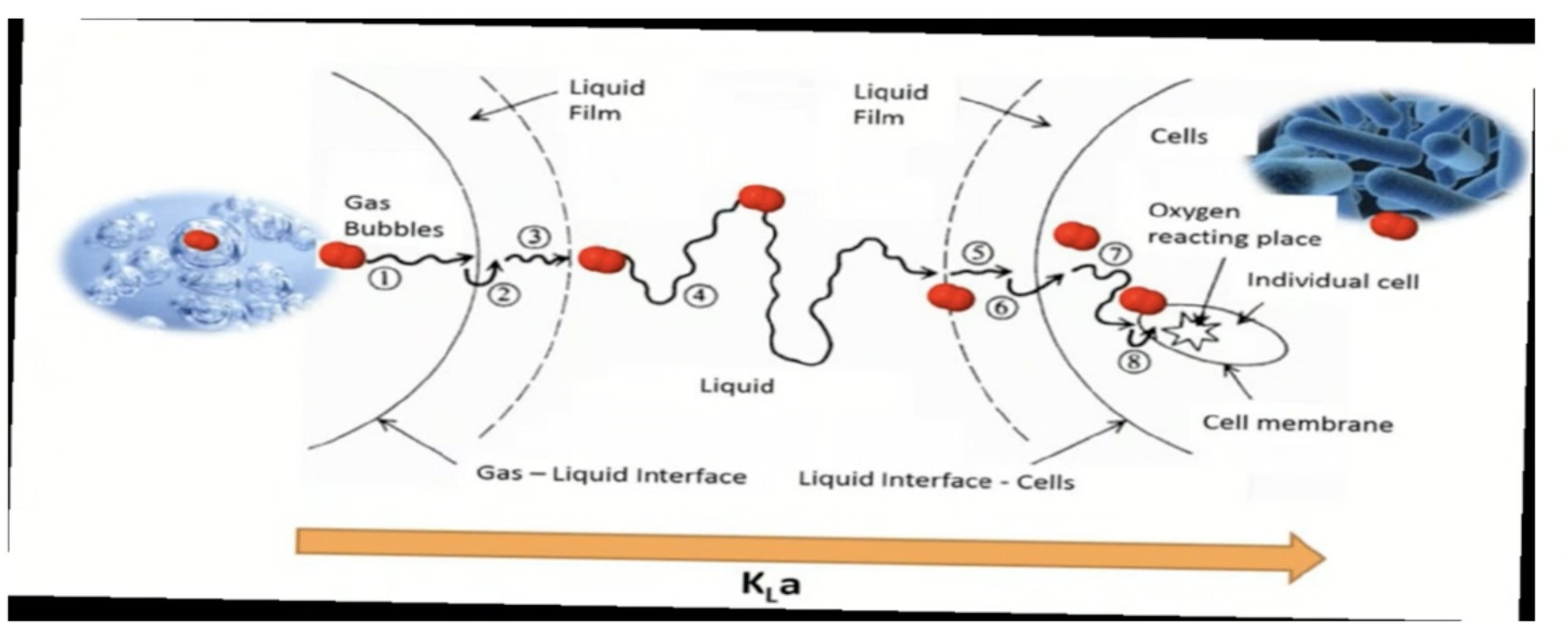
Oxygen travels from a gas bubble to a cell's reaction site through eight resistances in series:
- Transfer from the interior of the bubble to the gas-liquid interface
- Transfer across the gas-liquid interface
- Diffusion through the liquid film around the bubble
- Transport through the bulk liquid
- Diffusion through the liquid film around the cell
- Movement across the liquid-cell interface
- For cells in a clump, diffusion to the individual cell
- Transport through the cytoplasm to the reaction site
Step 3 — diffusion through the liquid film around the bubble — is the largest resistance, which is why (built around that film) is the parameter that governs overall oxygen transfer.
This holds for free unicellular cells in well-mixed suspension, and rests on two other facts about the eight steps:
- Step 2 (gas-film resistance) is negligible. O diffuses roughly four orders of magnitude faster in the gas phase than in the liquid phase, so for a sparingly-soluble gas like O almost all the resistance sits on the liquid side of the interface — this is why only the liquid-film coefficient () appears in , with no matching gas-film term.
- Step 5 (liquid film around the cell) is negligible for small, free cells. A single bacterium or yeast cell is small enough, and its own mass-transfer coefficient high enough, that this film contributes almost nothing next to step 3 — don't confuse it with the bubble's film.
Exception: mycelial pellets. For filamentous fungi growing as pellets or clumps (step 7 in the list), O must additionally diffuse through the biomass matrix to reach cells at the core. Past a critical pellet radius, this intra-pellet diffusion resistance dominates instead — large enough pellets can starve their core of oxygen entirely (an anoxic core), even when at the bubble is perfectly adequate. So "the liquid film around the bubble is always the dominant resistance" is only true for free-cell suspensions, not pelleted or flocculated growth.
Worked example: which resistance dominates, and when
In notes →Question. Which of the following statements about O transfer resistances from a gas bubble to a microbial cell in a stirred bioreactor are correct? (a) For unicellular bacteria in well-mixed suspension, the primary resistance is the liquid film around the gas bubble. (b) Gas-film resistance is practically negligible. (c) For fungal mycelial pellets, intra-pellet O diffusion is a significant resistance. (d) The liquid film around an individual bacterial cell is the dominant resistance for all aerobic bioprocesses.
Solution.
- For free unicellular cells, step 3 (liquid film around the bubble) is the largest of the eight resistances — (a) is correct.
- O's gas-phase diffusivity is far higher than its liquid-phase diffusivity, so the gas film (step 2) contributes negligible resistance — (b) is correct.
- Mycelial pellets add an extra resistance step not present for free cells: diffusion through the pellet's own biomass to reach interior cells, which becomes dominant past a critical pellet size — (c) is correct.
- (d) conflates two different films: the film around the cell (step 5, negligible for small free cells) with the film around the bubble (step 3, the actual dominant resistance) — and ignores that pellets shift the dominant resistance elsewhere entirely. "For all aerobic bioprocesses" is false.
Answer: (a), (b), and (c) are correct; (d) is false.
Worked example: which changes raise ?
In notes →Question. Which of the following operational modifications will result in an increase in in an agitated bioreactor? (a) Increasing the impeller rotational speed () (b) Increasing the sparging gas flow rate (c) Adding a chemical antifoam agent at high concentration (d) Replacing a large single orifice sparger with a sintered microsparger.
Solution.
- Higher impeller speed increases turbulence and breaks bubbles smaller — increases. (a) is correct.
- Higher gas flow rate means more gas hold-up and more total interfacial area — increases. (b) is correct.
- High-concentration antifoam promotes coalescence and adds interfacial resistance, both of which lower rather than raise it. (c) is incorrect.
- A sintered microsparger produces much finer bubbles than a large single orifice, raising — increases. (d) is correct.
Answer: (a), (b), and (d) increase ; (c) decreases it.
Worked example: which factors decrease
In notes →Question. Which of the following factors will cause a DECREASE in in an agitated fermenter? (a) Addition of excess chemical antifoam agents (b) Increase in broth apparent viscosity due to mycelial fungal growth (c) Increasing the agitation speed from rpm to rpm (d) Coalescence of smaller gas bubbles into larger bubbles.
Solution.
- Excess antifoam promotes coalescence and adds its own interfacial resistance — both lower — (a) decreases it.
- Higher viscosity increases resistance to oxygen transfer, lowering — (b) decreases it.
- increases directly with stirrer speed — raising rpm from to increases , it doesn't decrease it — (c) is not a decreasing factor.
- Coalescence increases , which lowers and therefore — (d) decreases it.
Answer: (a), (b), and (d) decrease ; (c) increases it instead.
Worked example: what the off-gas balance method does and doesn't need
In notes →Question. Select the CORRECT statements regarding the off-gas oxygen balancing method for measuring OTR: (a) It is a non-invasive, continuous method that can be applied during active fermentation. (b) It requires accurate measurement of inlet and exit gas flow rates and gas compositions. (c) It depends heavily on knowing the exact value of the liquid film thickness. (d) If respiratory quotient (RQ) is close to , inlet and outlet total volumetric gas flow rates are nearly equal.
Solution.
- The method only samples gas streams, never the broth, and runs continuously without interrupting the process — (a) is correct.
- The defining equation needs exactly and on both the inlet and outlet sides — (b) is correct.
- Film thickness is a film-theory construct behind , not something this macroscopic gas-phase mass balance ever measures — (c) is false.
- means moles of O consumed moles of CO produced, so the total gas-phase mole (and volumetric flow) count barely changes between inlet and outlet — (d) is correct.
Answer: (a), (b), and (d) are correct; (c) is false.
Worked example: which assertions about the respiring-cells variant are correct?
In notes →Question. Select the CORRECT assertions regarding the dynamic gassing-out method (Variant A, with a respiring culture) for determining :
- (a) The broth is first de-oxygenated by sparging nitrogen gas.
- (b) Dissolved oxygen is monitored as a function of time after air sparging is resumed.
- (c) The slope of versus time yields .
- (d) The method cannot be applied if living, respiring microorganisms are present.
Solution.
- In this variant, de-oxygenation comes specifically from the culture's own respiration once air is cut off — nitrogen sparging belongs to Variant B, not this one. (a) is incorrect here.
- This is exactly the recovery phase the method measures: air resumes and is tracked climbing back up. (b) is correct.
- The correct ratio uses (the level actually reached under respiration), not (the no-consumption saturation value) — see the distinction above. (c) is incorrect as stated.
- The opposite is true: this variant is specifically designed to be used with a living, respiring culture. (d) is incorrect.
Answer: (b) only.
Worked example: correctness checks across both variants
In notes →Question. Regarding the dynamic gassing-out method for determining in a fermenter, which of the following statements is/are CORRECT? (a) De-oxygenation of the broth is achieved by sparging nitrogen gas or shutting off aeration while respiring cells consume oxygen. (b) The slope of the line obtained by plotting against during re-aeration directly yields . (c) If the DO probe response time () is comparable to or larger than , probe lag must be corrected. (d) The method cannot be used if the liquid broth contains dissolved salts.
Solution.
- Both routes are real — they're just the two different named variants above (respiring-cells vs. nitrogen-stripping), not two options within a single technique. (a) is correct as a statement about the method family as a whole.
- This is the two-point slope form of the recovery curve. Note that here is only literally exact for Variant B (nitrogen-stripped); for Variant A the correct baseline is , not the true (see above). Read at the level this question intends, the underlying "slope of vs. time" technique is what yields either way. (b) is correct, with that caveat in mind.
- A slow DO probe can't track the true recovery curve once its own response time approaches the process time scale , so its lag must be corrected for — (c) is correct.
- Dissolved salts are present in essentially every real fermentation broth and don't interfere with this method — (d) is false.
Answer: (a), (b), and (c) are correct; (d) is false — but remember which baseline ( vs. ) is actually correct depends on which variant you're running.
Worked example: catalyst and reaction order in the sulphite method
In notes →Question. During measurement by the sulphite oxidation method, sodium sulphite is converted to sodium sulphate in the presence of a catalyst. The catalyst commonly used and the reaction order with respect to sulphite at moderate concentrations are: (a) Cu, first-order (b) Co, zero-order (c) Fe, second-order (d) Zn, half-order.
Solution.
- Co (cobaltous sulphate) is a standard catalyst for this reaction, alongside Cu — rules out (c) and (d), which use catalysts not associated with this method.
- The method's validity depends on the reaction being fast enough to never be rate-limiting: at moderate-to-high sulphite concentrations, the rate is independent of sulphite concentration — zero-order.
- (a) pairs a valid catalyst with the wrong order (first-order would make the reaction rate-limiting, defeating the method's purpose) — so only (b) pairs a valid catalyst with the correct kinetics.
Answer: (b) Co, zero-order.